
Audio Sermon
Listen to complete sermon series: Psalm 51
Sermon Transcript
We want to turn our Bibles to Psalms 51, Psalms 51 and verses 13 through 17. Then I will teach transgressors your ways, and sinners shall be converted unto you. Deliver me from blood-guiltiness, oh O God of my salvation, and my tongue shall sing aloud of your righteousness. O Lord, open my lips. And my mouth shall show forth your praise. For you desire not sacrifice, else I would give it. You delight not in burnt offering. The sacrifices of God are a broken spirit, A broken and a contrite heart. God, you will not despise.
We'll pray. Our Father in heaven, we thank you for this privilege. The unworthy yet Lord Father, you've given us this morning to come around these symbols and remember your Son. And now Father, even this morning, we sit before your Word. Lord Father, as we sung, here you find us in our weakness, falling before your throne, for our hearts desperately long for the healing and grace. And so we come, Lord Father, for your Word to be the balm of Gilead that heals our hearts and restores our souls unto Yourself. We pray that You will be glorified in the ministry of this Word. We ask this in the name of Your Son, Lord Jesus Christ. Amen.
It's been a while we've been considering Psalm 51 and somehow this passage that we are looking at is a climax to this Psalm where David comes face to face with what matters the most in his reconciliation. Imagine if you are going to buy a car, one of the things that will matter most is how much will it cost to maintain it. Well, once you have a car that is new, it doesn't cost much, it might be mostly free. But as the car ages, you begin to look at any corner of your car, you see a reason to get it fixed. And so you take that old car to a service center, you have a laundry list of things for it to be fixed and you just hoping that you don't get a big fat bill at the end of it.
Sometimes it becomes so critical things that has never happened before probably now you have to fix it and it becomes pretty expensive. Now if a wallet allowed for it you would really fix everything but sometimes it is so critical so difficult so tedious that it becomes pretty expensive. I want to take the example that brother Nitish spoke last Sunday evening over here of a Rolls Royce that broke down and to repair that car a helicopter had to be flying in the service engineers and repairing it in a remote location. Imagine the bill that comes for a service like that. It's a dread to even imagine what that price would be and that is just it's a very pale comparison to sometimes the cost and the sacrifice we need to pay for restoring our souls that are broken.
Where at the end of the day, buck has to stop somewhere. You need to face the cost and the consequence that one has to pay for restoration. You can pray your hearts out, you can wish all the things of this world, but at one point there comes a question of a cost. Sometimes how deep the mess is, that's how expensive the sacrifice is. And that's the dread that David is struggling and wrestling in this passage when he comes face to face with the bill of his restoration. It was also amazing all this while when he started the Psalm. We see it like a highway of mercy. There is abundance and abundance of mercy for David to be restored back to God.
Second, we saw that that highway of mercy leads to a pitch-dark of repentance because what's the point of mercy? if there is no repentance. So in that pit stop, we see David undoing himself, really repenting the way a sinner needs to repent. That pit stop of repentance, thirdly, led to a garage of repairs, where he has a laundry list, a long list of all things in his life that needs to be fixed. We saw in those last six verses, there were 12 things, 12 different ways David is asking every single aspect of his soul to be fixed by God. Well, that's only as far as the wish list goes. Finally, now David faces the bill of grace. That's inescapable.
Can grace be paid for? What would be the value of such a restoration that David is asking for? A restoration that talks of changing his own self? A restoration that talks of God taking away all his sins and the... Wrath thereof. A restoration where David is completely brought back to the joy of fellowship to God. This three-sided wholesome restoration where David is asking for his self, for his sins and for the fellowship. Complete restoration. Nothing is left out. Where David can be brought back to such joyful fellowship like he had never sinned before. If such is the restoration that God has to bring about in a messed-up life like David, what would be that cost?
Oh, the grace, the depth of grace, the depth of grace that can never be paid, which we can never value it, how can that be paid off? And so your David is struggling to put a value, to pay off, to compensate... to put something at the table for all what God has to do for him. He starts off in verse 13 and says, I will teach and that's his first offer. The first offer he brings to God, I'm going to teach transgressors, I'm going to see sinners converted to you. Before we look at the reasonableness of what David is offering, let's just admire and appreciate what is the offer. How beautiful is that desire!
that I am going to teach transgressors, where David sees his own sin has not an isolation, has not an exception, but he sees there are so many others who need to be taught like he has been. Isn't that a natural response to every sinner that has found grace of God? That this grace is not for me. There are others who are in need of this grace, who are dying of this grace, and I got to go and tell them, teach them. and see them converted, that I need to tell them of His ways. I'm not going to put myself on the pedestal and make people look at me and learn of my ways and how I messed up.
I'm not going to give them five ways to accept to escape adultery. I'm not going to give them ten different warnings. I'm going to teach them of the ways of the Lord that a sinner like me, an adulterer like me, keemer like me, A guy for the sake of covering up his sin will get somebody drunk, who will lie with a woman and father a child. person who has digged his grave so deep, God's ways can find him. That I would not keep this grace to myself. I will teach transgressors of the ways of God. It's the natural response. People with the most messed up lives, once they find grace, can never keep it to themselves.
You tell them to keep their mouth shut and you see them go across all the town and telling everyone of a healer that has healed them. And with no commandment, with no instigation, with no whatsoever command, they will go back to the centre square of the town and tell, I have found a person who has told everything that I have done. Who will care not of their shamefulness of the sin that they have committed, but for the sake of God's grace, they will open themselves in the centre square and say, I have found someone. who can tell everything that I have done. Imagine the humility, the cost that David himself is doing to pen a psalm like this.
where he is outrightly describing what he has done. Where he goes to the centre square of human history, writes a psalm, to this day is ministering to many sinners. You see this in the life of Paul as well, where Paul says, God has first shown in me His full-long suffering, first in me, His full-long suffering, that it should be an example, a pattern to all those that will believe in Him to everlasting life. And this is how we put it, the grace that was exceedingly abundant in the Lord. Here is David burning in that passion, knowing so very well, he is not the only sinner who needs that grace.
We are all those, we are all in our own lives and souls, the testimony of grace. How far have we taken that story? How far have we borne witness to the grace that God has worked in our lives? It's not about making people look at me. It's not the story of my life. It's His ways that needs to be displayed. But David comes with a stumbling block at this point. Because if it is just mere words that can pay the cost of grace, then that's too convenient. That if through the sinfulness of David, Other sinners should come to God and if that is the cost of grace, then that is too cheap.
If your evangelistic effort of telling other sinners is the price that you pay, you compensate for grace, then that is so insufficient. The cost of righteousness is so astronomically high where David says, deliver me from blood guiltiness. What's at stake is my very life. What can pay for it is my own blood. What can suffice the wrath of God is my own destruction, where I am guilty down to my very blood. And that's why it's said that there is no remission of sin till there is shedding of blood. So David is struggling. He has a great desire to teach. He has a great desire to sing aloud of the righteousness of God.
He has a great desire to show forth God's praise. And to add that in verse 16, He has a great desire to offer all kinds of sacrifices, where He could buy out every cattle in the world, offer all kinds of blood sacrifices, and all in its totality cannot suffice the price of blood. All in its totality cannot wipe away His sin. All in its totality cannot pay for the restoration He's asking for. What can be the price for His sin? This is how a hymn writer puts it, When my accuser makes the claim that I should die for my offence, I point him to that rugged frame where I found life at Christ's expense.
See from his hands, his feet, his side, a fountain flowing deep and wide. Oh, here it shouts the victory that the blood of Jesus speaks for me. Here is David enjoying the blood of Christ in his life, for his life. where there was no sacrifice that could be offered, there were no pompous words that could be offered as praise, there was no great prize that could be paid, yet David writes of the blessedness of a person who finds forgiveness of his iniquities, where David writes of the blessedness of a God who doesn't deal with us according to our iniquities, a God who is ready to separate our sins from us as far as the East is from the West.
A God who's so slow to anger, to see through David, through nine months of madness and still spare his life. Here is a God who offers his own son and the very blood, a fountain that's deep and wide, that's shouting, that blood will speak for David and for us. You see, this is David speaking out of an experience of receiving full forgiveness. It's one thing to sing of a love that's deep and deep and vast and unmeasured and full but here is David who has taken a plunge in that ocean that's vast that's full that's unmeasured that's rolling over over him leading him to God.
And after taking plunge in that deep deep love of God he's writing this declaring the ways of God you see David over here struggling with his mouth in verse 15 he says open my lips he's struggling to even open his lips He wants to teach, he wants to sing, he wants to show forth the praise of God. But he has come to a point where now he is praying, O Lord, You open my lips and then my mouth will show forth Your praise. A man who could play all kinds of instruments, the sweetest hymn... the hymn writer of Israel comes to a point where he finds his mouth shut, finds himself with his hands tied.
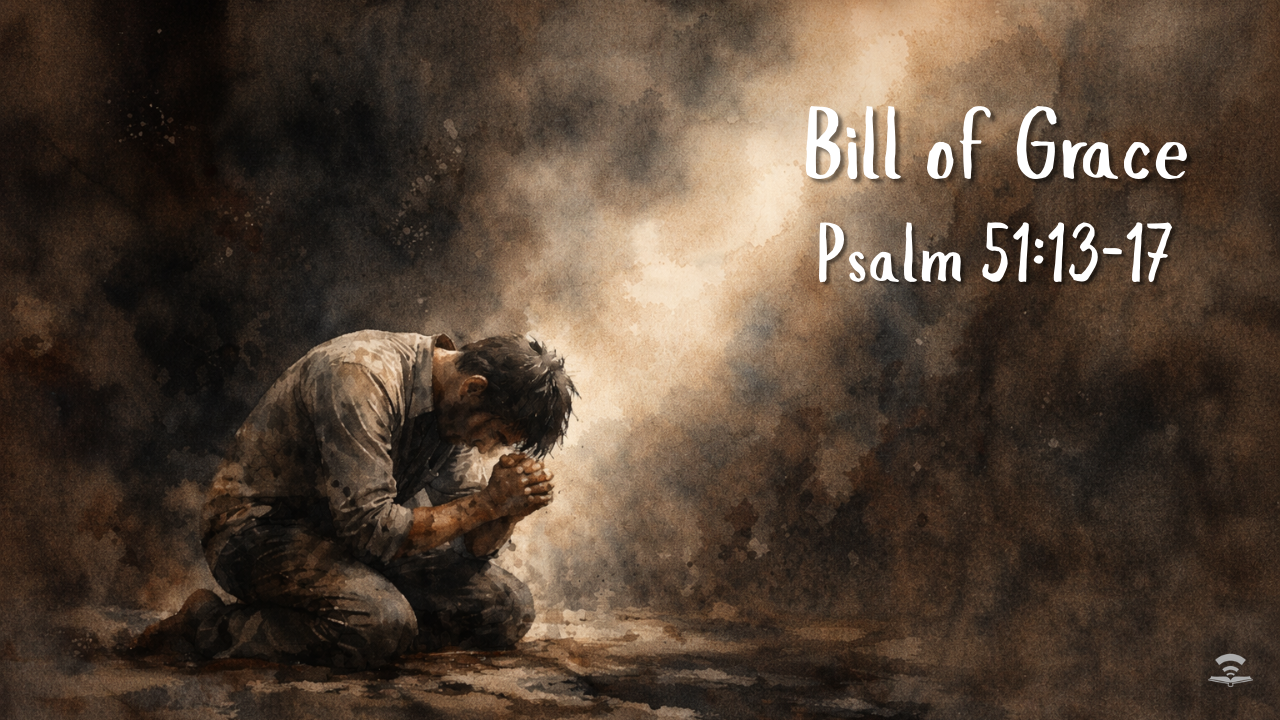
where He can't offer a sacrifice, where there can be no blood offered, no great works that He can offer, all He has to wait and depend on a God that pays for His sin in full. So for this great ocean of God's grace, how does David respond? To a bill that can never be paid, what David eventually does? In verse 17, He says, the sacrifices of our God are a broken spirit. A broken and a contrite heart of God you will not despise. I love it how it is written in Hindi, Tute or Pise, a heart that is broken and grounded. That's the finest response of a sinner to a grace that can never be paid for.
I can't bring worship, I can't bring great words of praise, I can't sing those same songs of God. I can't offer a thousand sacrifices. All I can give is broken heart, a grounded heart, a heart that's completely broken for God. This is the most difficult thing for us to offer. If God had asked of us thousand sacrifices, we would have done it. If God had asked us to go to Jerusalem, like folks go to Mecca, we would have done it every month. If God would have asked of us money, we would have given it. God is not asking anything except our whole life in its totality broken and served to God.
What does the Bible say of a broken heart? That God is nigh to a heart that's broken. That God does not despise a broken and a contrite heart. That God dwells with those that are broken and contrite. This is what the Lord expects of us, that we break down, we are broken and contrite in our heart. It's like the songwriter that writes it in Hindi, that we have a God that... A God who blesses broken hearts with thousands of reasons to praise. May God’s name be glorified.

Podcast: Play in new window | Download
Subscribe: Apple Podcasts | Spotify | RSS