
Audio Sermon
Download
Listen to complete sermon series: Psalm 51
Sermon Transcript
Psalm 51 and as we conclude this psalm today, we read the whole psalm. Have mercy upon me, O God, according to Your loving-kindness, according to the multitude of Your tender mercies. Plot out my transgressions. Wash me thoroughly from my iniquity. Cleanse me from my sin. For I acknowledge my transgressions, and my sin is ever before me. against you, you only have I sinned and done this evil in your sight, that you may be found just when you speak and be blameless when you judge. Behold, I was brought forth in iniquity and in sin that my mother conceived me. Behold, you desired truth in the inward paths and in the hidden you shall make me to know wisdom.
Purge me with His soap and I shall be clean. Wash me and I shall be whiter than snow. Make me to your joy and gladness that the bones which you have broken may rejoice. Hide your face from my sins and blot out all my inequities. Create in me a clean heart, O God, and renew a right spirit within me. Cast me not away from your presence. and take not your Holy Spirit from me. Restore unto me the joy of your salvation, and uphold me with your generous Spirit. Then will I teach transgressors your ways, and sinners shall be converted unto you. Deliver me from blood-guiltiness, O God, you God, of my salvation, and my tongue shall sing aloud of your righteousness.
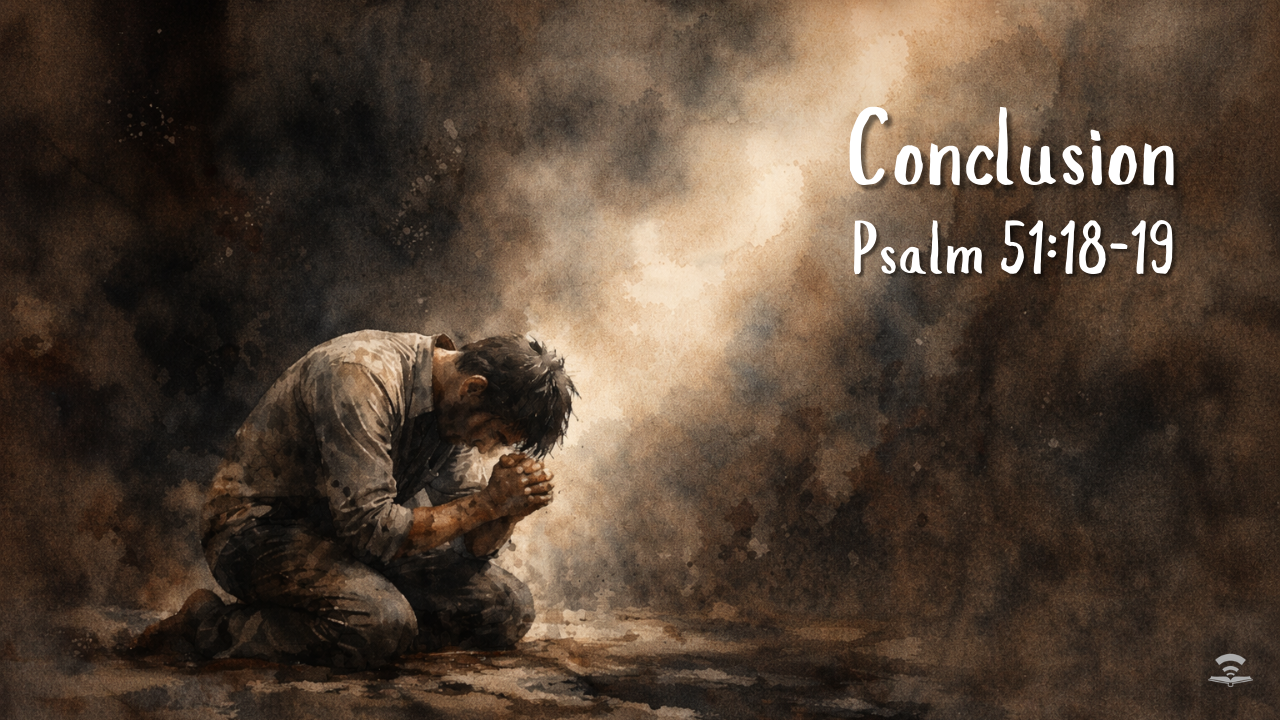
O Lord, open my lips and my mouth shall show forth your praise. For you desire not sacrifice, else I would give it, with delight not in burnt offering. The sacrifices of God are a broken spirit, a broken and a contrite heart of God you will not despise. Do good in your good pleasure unto Zion, build the walls of Jerusalem, then you will be pleased with the sacrifice of righteousness. with burnt offering and whole burnt offering, then shall they offer bullocks upon your altar. You read verse 18 and 19 once again, Do good in your good pleasure unto Zion, build the walls of Jerusalem, then shall you be pleased with the sacrifices of righteousness with burnt offering and whole burnt offering, then shall they offer bullocks upon your altar.
The pertinent question in every restoration is, till what extent can one be restored? That if God desires of us, we be broken and that we be grind in pieces like how David says in the previous verse, 17. then what is God going to do with that brokenness? How much can God restore? To what extent? To what scope? To what limit? And sufficiently, as David ends this prayer of repentance, he addresses this aspect, expecting of God an eternal and infinite restoration.
Let's look at verse 18 and 19. we'll immediately realize that there is a deviation from all what David has spread so far. Some words appear in these last two verses that were there in the whole previous Saam. He's talking of Zion, he's talking of Jerusalem and an anonymous Dey, we do not know who, but he's talking of Dey, who will offer bullocks upon God's altar. And that's very very surprising because this whole Saam was so... personal to David where everything about this Psalm is about what he did and what he expects of God that suddenly now there is a deviation to Zion, to Jerusalem and to an anonymous group of people who he wants them to offer sacrifice and this follows on the heels of his own brokenness where he has reached a point of offering nothing to God but his brokenness.
Is David changing the topic suddenly? More importantly, what is the topic? What is he actually saying in these last two verses? From talking intensely about the restoration that he wants of his soul, why should he now talk about the walls of Jerusalem? What does the walls of Jerusalem ever got to do with the sin of adultery that he has committed? And after having expressed his inability to worship God through words or sacrifices, but only by giving brokenness, now he's calling upon sacrifices, literally whole-born sacrifices, literally bullocks, the most expensive sacrifice one can put up with. He's calling all of that to be offered. From saying that God does not desire sacrifice, He is now ending on a note saying, you will be pleased with sacrifices.
From saying of His own unrighteousness, of His sinfulness, of His iniquity, He is now talking of the sacrifices of righteousness. Well, it's very easy to understand when Someone has a topic in his mind by seeing a number of repetitions. He doesn't want to just talk at once. It's very natural in our culture as well, where we want to emphasize something, we'll see it again and again. And you see that word pleasure in verse 18. You see it again in verse 19, you will be pleased. Again in verse 18, you see the word good, do good, and in your good pleasure. And that's the crux of what David is coming to. He's coming to good pleasure. Good pleasure. God's good pleasure. Now that's a very strange way to end a prayer of repentance.
Probably we'll understand repentance to be all about ourselves, where we pray our hearts out and ask God's forgiveness. But now David ends that on the note of God's good pleasure. And what a beautiful way to talk of God's pleasure as being good! This is not the only place where it is written in such a manner. It's a language consistent in the scriptures where God is said to have good pleasure. It's literally Paul that takes the same two phrases, two words, and he uses numerous times in his epistle by saying, he has predestinated us according to his good pleasure. And then Paul adds by saying, the good pleasure of his will. Again, he says in the same passage, his will according to his good... pleasure which he purposed in himself, where God's will is synonymous to His pleasure.
There's a time when the Lord told us that we have to seek His Kingdom first, not food, not clothes, not the things that the nations run after, but seek the Kingdom of God first. And the Lord continued to say, it is your Father's good pleasure to give you His Kingdom. It is your Father's good pleasure to give you His Kingdom. This is again how Paul says in Philippians, God which works in you, both to will and to do, His good pleasure. God works in us, both to will, that a will of or His desire should be generated in us, both to will and to do, His good pleasure. That God is in constant work in our hearts, that we renounce our will, our desire, and we end up desiring and doing His good pleasure!
Psalm 115, again the Psalmist says the same thing, God has done everything in heaven according to what He is pleased with. Isaiah 53, the very famous passage on the sufferings of Christ, ends with the note that the pleasure of the Lord will prosper in the hand of Christ. Now brethren, that is the end goal of everything. It is the end game of everything. It is the logical, the reasonable conclusion of all history, of all time. The good pleasure of the Lord which He has purposed according to His will will be brought to pass. That God has willed only good and the things that He has willed concerning us is His pleasure. And that's why it could please the Lord to crush the Lord Jesus on the cross.
That it is a pleasure of the Lord to crush His Son that through His blood there should be remission offered to many. God created all things according to His good pleasure. The sin of man, the rebellion of man cannot deviate, cannot dissolve or dilute God's pleasure. It will still be brought to pass that if God has to be glorified in His creation, He will also be glorified in the redemption of that creation, that He will do all things according to His will in which He has taken much pleasure. Now coming back to David to consider what a way to end a prayer of repentance. After expressing his whole heart's desire with extreme intense emotions, he comes to a point and says, Lord, let your good will be done. How beautiful!
We can pour our hearts out, asking and pleading God's mercy, but more than our own desires, it is God's good pleasure to be merciful towards us. That God desires of us, His pleasure, His good pleasure is much more than what we can desire for our own selves. So therefore, instead of banking upon our own penitent heart and the fervent prayers that we can bring toward God, we can bank on God's will, on God's good pleasure that has never failed. So the final words of David is, Lord, You do good according to Your good pleasure. It's always good to end all prayers that way. It's the way the Lord ended His prayer and gets him nailed, not my will, but Your will be done.
For prayer is not expressing what we want, but saying, Lord, I want what You want. So David ended his prayer merely reflecting, merely banking upon God's good pleasure than more than what he wants. Let's also look at the aspect of how different is David as he ends this prayer. How his heart and mind has completely changed now. How it is not natural of each of us in our own natural state or our natural being to desire what God desires. And after having committed a sin of pleasure, Now David is talking of God's good pleasure. After having set his mind on the lust of the flesh, the lust of the eyes, the pride of life, the things that the world offers him, changing his viewpoint, his focus from the world to what God's good pleasure is.
This is not little, it's a phenomenal change. I was uh remembering an incident that happened once with a person called Icabold Spencer. It was many, many 200 years ago, I think, where he was visiting a very old, ailing woman who was suffering from consumption or what we today call TB. And she was on the verge of death. She was failing. And in that midst of pain, Iqbal asked her, do you want to be healed? And she says, No, I have no desire to continue in this world. I have renounced this world and I have chosen what is yet to come. And I truly wish we have that beautiful attitude, an attitude of renunciation, that it should not take a near-death experience or a terminal disease to bring about an attitude of renouncing this world.
But like Moses, who would denounce, he would deny the fleeting pleasures of this world, of Egypt. And that's the challenge, that's the competition. Are we going to... Are we going to indulge ourselves in the pleasures of this world that are fleeting and that's for a time and a season? That got David into so much problem and so much trouble. Or are we going to renounce the pleasures, the desires, the things that attract us in this world so as to desire the pleasures of God? And this is upon us brethren, because this is how the last days is going to be, as Paul says, it's going to be filled with people that despise good, that love themselves, that love pleasures more than being lovers of God.
that it is going to be stronger and stronger as the day's end, where it will be strong to enjoy, to enjoy the pleasures of this world, to love the things that are not good. You see, this is what brokenness does to a person. He no more desires the things and the pleasures and the sensual desires that he enjoyed once. The lust of the flesh, the lust of the eyes, pride of life, all these things that are in the world are not of the Father. and to make ourselves lovers of these things, we make ourselves enemies of God. That if we have to love these things, then the love of God cannot be in us. The question is, what are we going to desire? What is going to be our earnest desire?
The things that are not of the Father? The things that are of this world? Things whose source cannot be traced back to God? Or the things that are of God? The good pleasure of His will? Can it be our meat and our drink like it was to the Lord Jesus Christ? You see, David learned that lesson so, so hard after having sinned and after being made broken. Sin entered into the world because of this. Because we in Adam and Eve desired what God said no. Let's look into what entails that good pleasure. That if we were to ask God's good pleasure to be done, do good, we are asking God to do good in His good pleasure, what does that mean? There are two things written here.
One is, build the walls of Jerusalem. And then, then, which means not before that, then, after the walls are done, God will be pleased with the sacrifice that are being offered in Jerusalem. And the impression is that once the walls are done, there will be a lot of sacrifices, even bullocks, and God is going to be happy, He is going to be pleased with it. Well, what is David specifically talking here? He's talking of Zion. Good pleasure unto Zion. He's talking of the time where God has promised David that God will never lack a man to sit on the throne of Israel, where David is now going way into the future, to the eternal restoration of all things created.
He writes this sitting in the city of David where one day it will be called the city of God. He writes this in Jerusalem which is merely a national interest to one country but will soon become the joy of all the earth. He writes this being the King of Israel where one day in that same place will be the King of Kings. And so if he's asking for anything, he's saying, Lord, you get going, you get going. Never go back. Do good in that good pleasure unto Zion. It's like, let not my foolishness, let not my sinfulness, let not my wickedness that I have done being a King of Israel affect your future, the will that you have desired concerning Zion.
After having requested everything that He has to request for Himself, now He's saying, Lord, let your will be done, that He warns not His sin to have an effect on the future. You see, this can be considered lightly, but our sins have far-reaching ramifications. that extend many generations in the future if you do not be careful and that's the reason why he refers to the walls of Jerusalem. When David warned the city of Jerusalem it was under the control of Jebusites. David first fought and got it under his control. Jerusalem was known for its walls and it is understood from that passage that Jebusites thought that their fortress, their walls are so strong that even a blind and a lame person can defend the city.
And that is what this wall signified. It signifies protection and security for those that are inside. Soon after he captured the city of Jerusalem, he started to fortify it all the more. We read of something called Millo that he built, where he fortified it all the more with walls. But all that he was doing towards the walls of Jerusalem had a much more significant future meaning, that there was something that God is going to do for the walls of Jerusalem. When God restores Zion, when God restores the city of Jerusalem, He says He is going to set watchmen upon these walls and these watchmen are not going to be silent day and night.
They will continuously voice and sing that the Lord reigns, that these walls are going to signify that within these walls reigns the Lord. This is Isaiah puts it. He says, But the Lord shall arise upon you, and His glories shall be seen upon you. Again He says, Sun shall no more be your light by day, neither brightness shall moon give for light, but the Lord shall be unto you an everlasting light, and your God, your glory. The Lord shall be your everlasting light. And that's when the Lord says, you will call the walls of Jerusalem salvation. and its gates praise that the walls of Jerusalem will be named salvation. Anyone who walks through it will be saved, will be safe.
Again through Zechariah the Prophet says, I the Lord say that I will be unto her a wall of fire round about and will be the glory in the midst of her. It is going to be so glorious where Jerusalem is going to be an epitome of God's glory. There is written that righteousness shall go forth as brightness and righteousness shall go forth as brightness across the world and salvation has the lamp. Where Jerusalem will be called the crown of the Lord, the diadem of the Lord, where Jerusalem will no more be called Azuba, which means forsaken, neither will she be called Shemama, which means desolate, but she will be called Hepzibah, which means my delight is in her.
That's what David is praying for. That Lord, your good pleasure should be done towards Zion, should be done towards Jerusalem. And she'll be called Bula, which means she's married because the Lord will rejoice over Jerusalem like a bridegroom rejoices over his bride. This is the end of all things. And in praying for his repentance and restoration, David prays, Lord bring forth your kingdom into Zion and into Jerusalem. where God will be the glory in the midst of her. Then will the Lord be pleased? You see, the Lord had this contention towards the people that your sacrifices are defiled. The Lord at once said, when you offer a lamb, it's like you cut a dog's neck.
Or when you offer your oblations, it's like you offer swine's blood. Or as if you bow down to an idol. That's how the Lord looked at the sacrifices of sinful men. But then David talks of a Zion, of a Jerusalem. where there will be walls of salvation, gates of praise and everything that is offered in the midst of it will be righteousness. A God will take pleasure in what is offered there. Let's conclude with that question. How much will the Lord restore? To what extent? To what scope? After having mangled and despised and destroyed our life with our own sins, how much can we expect of the Lord to restore us? It's like the songwriter who says, something beautiful, something good.
How much beautiful can the Lord make it? When all we have to offer is brokenness and strife, how much beautiful can the Lord make it? How much beauty can God bring forth out of ashes? Well, you see, if you cut a string of thread and you try to join it back, it will always join back with a knot. There's just no way you can avoid a knot. Well, you want it to be as good as it was before. and it's impossible to even get to what it was before, then won't it be all the more unreasonable to ask for something way more glorious, way more beautiful than what it was before? When you take a mangled car to a workshop, you expect that the car to be as good as it was before.
What you don't really expect is that the car looks extremely beautiful, extremely much much more grand than what it was to begin with. Well, you can reasonably... Expect at least a normal, at least to get back what it was before. Well, can you expect more than that? Would it be reasonable for the Lord to restore to an extent where the end is better than the first? There were great glories that Adam lost when he sinned. Hasn't the Lord restored unto us much, much more great glories than what Adam lost? And that's why in a prayer of repentance it's so fitting for David to talk about the future because the restoration of a sinner and it's not limited to this earth.
where we can come to the Lord with all our defilements, with the greatest spots of our blackness, and God has assured us of an eternity where we will be robed with righteousness of Christ. The world is yet to see, the principalities and the powers that be in heavenly places are yet to see, the far riches of God's glory, of God's grace, that He is yet to show forth on the Church. So today we might deal with broken bones, where David says, Lord, let me rejoice with those broken bones. And after this sin, he never had a peaceful life. And after this sin, he was not seen to be serving the Lord like he ever did before.
The consequences of his sin, he carried it to his death. But this life is not the end of it all. God will bring forth His good pleasure either ways. And that the full restoration of a sinner is when we are enjoined with Him in His glories. My God, it's the name of the glorified.
Purge me with His soap and I shall be clean. Wash me and I shall be whiter than snow. Make me to your joy and gladness that the bones which you have broken may rejoice. Hide your face from my sins and blot out all my inequities. Create in me a clean heart, O God, and renew a right spirit within me. Cast me not away from your presence. and take not your Holy Spirit from me. Restore unto me the joy of your salvation, and uphold me with your generous Spirit. Then will I teach transgressors your ways, and sinners shall be converted unto you. Deliver me from blood-guiltiness, O God, you God, of my salvation, and my tongue shall sing aloud of your righteousness.
O Lord, open my lips and my mouth shall show forth your praise. For you desire not sacrifice, else I would give it, with delight not in burnt offering. The sacrifices of God are a broken spirit, a broken and a contrite heart of God you will not despise. Do good in your good pleasure unto Zion, build the walls of Jerusalem, then you will be pleased with the sacrifice of righteousness. with burnt offering and whole burnt offering, then shall they offer bullocks upon your altar. You read verse 18 and 19 once again, Do good in your good pleasure unto Zion, build the walls of Jerusalem, then shall you be pleased with the sacrifices of righteousness with burnt offering and whole burnt offering, then shall they offer bullocks upon your altar.
The pertinent question in every restoration is, till what extent can one be restored? That if God desires of us, we be broken and that we be grind in pieces like how David says in the previous verse, 17. then what is God going to do with that brokenness? How much can God restore? To what extent? To what scope? To what limit? And sufficiently, as David ends this prayer of repentance, he addresses this aspect, expecting of God an eternal and infinite restoration.
Let's look at verse 18 and 19. we'll immediately realize that there is a deviation from all what David has spread so far. Some words appear in these last two verses that were there in the whole previous Saam. He's talking of Zion, he's talking of Jerusalem and an anonymous Dey, we do not know who, but he's talking of Dey, who will offer bullocks upon God's altar. And that's very very surprising because this whole Saam was so... personal to David where everything about this Psalm is about what he did and what he expects of God that suddenly now there is a deviation to Zion, to Jerusalem and to an anonymous group of people who he wants them to offer sacrifice and this follows on the heels of his own brokenness where he has reached a point of offering nothing to God but his brokenness.
Is David changing the topic suddenly? More importantly, what is the topic? What is he actually saying in these last two verses? From talking intensely about the restoration that he wants of his soul, why should he now talk about the walls of Jerusalem? What does the walls of Jerusalem ever got to do with the sin of adultery that he has committed? And after having expressed his inability to worship God through words or sacrifices, but only by giving brokenness, now he's calling upon sacrifices, literally whole-born sacrifices, literally bullocks, the most expensive sacrifice one can put up with. He's calling all of that to be offered. From saying that God does not desire sacrifice, He is now ending on a note saying, you will be pleased with sacrifices.
From saying of His own unrighteousness, of His sinfulness, of His iniquity, He is now talking of the sacrifices of righteousness. Well, it's very easy to understand when Someone has a topic in his mind by seeing a number of repetitions. He doesn't want to just talk at once. It's very natural in our culture as well, where we want to emphasize something, we'll see it again and again. And you see that word pleasure in verse 18. You see it again in verse 19, you will be pleased. Again in verse 18, you see the word good, do good, and in your good pleasure. And that's the crux of what David is coming to. He's coming to good pleasure. Good pleasure. God's good pleasure. Now that's a very strange way to end a prayer of repentance.
Probably we'll understand repentance to be all about ourselves, where we pray our hearts out and ask God's forgiveness. But now David ends that on the note of God's good pleasure. And what a beautiful way to talk of God's pleasure as being good! This is not the only place where it is written in such a manner. It's a language consistent in the scriptures where God is said to have good pleasure. It's literally Paul that takes the same two phrases, two words, and he uses numerous times in his epistle by saying, he has predestinated us according to his good pleasure. And then Paul adds by saying, the good pleasure of his will. Again, he says in the same passage, his will according to his good... pleasure which he purposed in himself, where God's will is synonymous to His pleasure.
There's a time when the Lord told us that we have to seek His Kingdom first, not food, not clothes, not the things that the nations run after, but seek the Kingdom of God first. And the Lord continued to say, it is your Father's good pleasure to give you His Kingdom. It is your Father's good pleasure to give you His Kingdom. This is again how Paul says in Philippians, God which works in you, both to will and to do, His good pleasure. God works in us, both to will, that a will of or His desire should be generated in us, both to will and to do, His good pleasure. That God is in constant work in our hearts, that we renounce our will, our desire, and we end up desiring and doing His good pleasure!
Psalm 115, again the Psalmist says the same thing, God has done everything in heaven according to what He is pleased with. Isaiah 53, the very famous passage on the sufferings of Christ, ends with the note that the pleasure of the Lord will prosper in the hand of Christ. Now brethren, that is the end goal of everything. It is the end game of everything. It is the logical, the reasonable conclusion of all history, of all time. The good pleasure of the Lord which He has purposed according to His will will be brought to pass. That God has willed only good and the things that He has willed concerning us is His pleasure. And that's why it could please the Lord to crush the Lord Jesus on the cross.
That it is a pleasure of the Lord to crush His Son that through His blood there should be remission offered to many. God created all things according to His good pleasure. The sin of man, the rebellion of man cannot deviate, cannot dissolve or dilute God's pleasure. It will still be brought to pass that if God has to be glorified in His creation, He will also be glorified in the redemption of that creation, that He will do all things according to His will in which He has taken much pleasure. Now coming back to David to consider what a way to end a prayer of repentance. After expressing his whole heart's desire with extreme intense emotions, he comes to a point and says, Lord, let your good will be done. How beautiful!
We can pour our hearts out, asking and pleading God's mercy, but more than our own desires, it is God's good pleasure to be merciful towards us. That God desires of us, His pleasure, His good pleasure is much more than what we can desire for our own selves. So therefore, instead of banking upon our own penitent heart and the fervent prayers that we can bring toward God, we can bank on God's will, on God's good pleasure that has never failed. So the final words of David is, Lord, You do good according to Your good pleasure. It's always good to end all prayers that way. It's the way the Lord ended His prayer and gets him nailed, not my will, but Your will be done.
For prayer is not expressing what we want, but saying, Lord, I want what You want. So David ended his prayer merely reflecting, merely banking upon God's good pleasure than more than what he wants. Let's also look at the aspect of how different is David as he ends this prayer. How his heart and mind has completely changed now. How it is not natural of each of us in our own natural state or our natural being to desire what God desires. And after having committed a sin of pleasure, Now David is talking of God's good pleasure. After having set his mind on the lust of the flesh, the lust of the eyes, the pride of life, the things that the world offers him, changing his viewpoint, his focus from the world to what God's good pleasure is.
This is not little, it's a phenomenal change. I was uh remembering an incident that happened once with a person called Icabold Spencer. It was many, many 200 years ago, I think, where he was visiting a very old, ailing woman who was suffering from consumption or what we today call TB. And she was on the verge of death. She was failing. And in that midst of pain, Iqbal asked her, do you want to be healed? And she says, No, I have no desire to continue in this world. I have renounced this world and I have chosen what is yet to come. And I truly wish we have that beautiful attitude, an attitude of renunciation, that it should not take a near-death experience or a terminal disease to bring about an attitude of renouncing this world.
But like Moses, who would denounce, he would deny the fleeting pleasures of this world, of Egypt. And that's the challenge, that's the competition. Are we going to... Are we going to indulge ourselves in the pleasures of this world that are fleeting and that's for a time and a season? That got David into so much problem and so much trouble. Or are we going to renounce the pleasures, the desires, the things that attract us in this world so as to desire the pleasures of God? And this is upon us brethren, because this is how the last days is going to be, as Paul says, it's going to be filled with people that despise good, that love themselves, that love pleasures more than being lovers of God.
that it is going to be stronger and stronger as the day's end, where it will be strong to enjoy, to enjoy the pleasures of this world, to love the things that are not good. You see, this is what brokenness does to a person. He no more desires the things and the pleasures and the sensual desires that he enjoyed once. The lust of the flesh, the lust of the eyes, pride of life, all these things that are in the world are not of the Father. and to make ourselves lovers of these things, we make ourselves enemies of God. That if we have to love these things, then the love of God cannot be in us. The question is, what are we going to desire? What is going to be our earnest desire?
The things that are not of the Father? The things that are of this world? Things whose source cannot be traced back to God? Or the things that are of God? The good pleasure of His will? Can it be our meat and our drink like it was to the Lord Jesus Christ? You see, David learned that lesson so, so hard after having sinned and after being made broken. Sin entered into the world because of this. Because we in Adam and Eve desired what God said no. Let's look into what entails that good pleasure. That if we were to ask God's good pleasure to be done, do good, we are asking God to do good in His good pleasure, what does that mean? There are two things written here.
One is, build the walls of Jerusalem. And then, then, which means not before that, then, after the walls are done, God will be pleased with the sacrifice that are being offered in Jerusalem. And the impression is that once the walls are done, there will be a lot of sacrifices, even bullocks, and God is going to be happy, He is going to be pleased with it. Well, what is David specifically talking here? He's talking of Zion. Good pleasure unto Zion. He's talking of the time where God has promised David that God will never lack a man to sit on the throne of Israel, where David is now going way into the future, to the eternal restoration of all things created.
He writes this sitting in the city of David where one day it will be called the city of God. He writes this in Jerusalem which is merely a national interest to one country but will soon become the joy of all the earth. He writes this being the King of Israel where one day in that same place will be the King of Kings. And so if he's asking for anything, he's saying, Lord, you get going, you get going. Never go back. Do good in that good pleasure unto Zion. It's like, let not my foolishness, let not my sinfulness, let not my wickedness that I have done being a King of Israel affect your future, the will that you have desired concerning Zion.
After having requested everything that He has to request for Himself, now He's saying, Lord, let your will be done, that He warns not His sin to have an effect on the future. You see, this can be considered lightly, but our sins have far-reaching ramifications. that extend many generations in the future if you do not be careful and that's the reason why he refers to the walls of Jerusalem. When David warned the city of Jerusalem it was under the control of Jebusites. David first fought and got it under his control. Jerusalem was known for its walls and it is understood from that passage that Jebusites thought that their fortress, their walls are so strong that even a blind and a lame person can defend the city.
And that is what this wall signified. It signifies protection and security for those that are inside. Soon after he captured the city of Jerusalem, he started to fortify it all the more. We read of something called Millo that he built, where he fortified it all the more with walls. But all that he was doing towards the walls of Jerusalem had a much more significant future meaning, that there was something that God is going to do for the walls of Jerusalem. When God restores Zion, when God restores the city of Jerusalem, He says He is going to set watchmen upon these walls and these watchmen are not going to be silent day and night.
They will continuously voice and sing that the Lord reigns, that these walls are going to signify that within these walls reigns the Lord. This is Isaiah puts it. He says, But the Lord shall arise upon you, and His glories shall be seen upon you. Again He says, Sun shall no more be your light by day, neither brightness shall moon give for light, but the Lord shall be unto you an everlasting light, and your God, your glory. The Lord shall be your everlasting light. And that's when the Lord says, you will call the walls of Jerusalem salvation. and its gates praise that the walls of Jerusalem will be named salvation. Anyone who walks through it will be saved, will be safe.
Again through Zechariah the Prophet says, I the Lord say that I will be unto her a wall of fire round about and will be the glory in the midst of her. It is going to be so glorious where Jerusalem is going to be an epitome of God's glory. There is written that righteousness shall go forth as brightness and righteousness shall go forth as brightness across the world and salvation has the lamp. Where Jerusalem will be called the crown of the Lord, the diadem of the Lord, where Jerusalem will no more be called Azuba, which means forsaken, neither will she be called Shemama, which means desolate, but she will be called Hepzibah, which means my delight is in her.
That's what David is praying for. That Lord, your good pleasure should be done towards Zion, should be done towards Jerusalem. And she'll be called Bula, which means she's married because the Lord will rejoice over Jerusalem like a bridegroom rejoices over his bride. This is the end of all things. And in praying for his repentance and restoration, David prays, Lord bring forth your kingdom into Zion and into Jerusalem. where God will be the glory in the midst of her. Then will the Lord be pleased? You see, the Lord had this contention towards the people that your sacrifices are defiled. The Lord at once said, when you offer a lamb, it's like you cut a dog's neck.
Or when you offer your oblations, it's like you offer swine's blood. Or as if you bow down to an idol. That's how the Lord looked at the sacrifices of sinful men. But then David talks of a Zion, of a Jerusalem. where there will be walls of salvation, gates of praise and everything that is offered in the midst of it will be righteousness. A God will take pleasure in what is offered there. Let's conclude with that question. How much will the Lord restore? To what extent? To what scope? After having mangled and despised and destroyed our life with our own sins, how much can we expect of the Lord to restore us? It's like the songwriter who says, something beautiful, something good.
How much beautiful can the Lord make it? When all we have to offer is brokenness and strife, how much beautiful can the Lord make it? How much beauty can God bring forth out of ashes? Well, you see, if you cut a string of thread and you try to join it back, it will always join back with a knot. There's just no way you can avoid a knot. Well, you want it to be as good as it was before. and it's impossible to even get to what it was before, then won't it be all the more unreasonable to ask for something way more glorious, way more beautiful than what it was before? When you take a mangled car to a workshop, you expect that the car to be as good as it was before.
What you don't really expect is that the car looks extremely beautiful, extremely much much more grand than what it was to begin with. Well, you can reasonably... Expect at least a normal, at least to get back what it was before. Well, can you expect more than that? Would it be reasonable for the Lord to restore to an extent where the end is better than the first? There were great glories that Adam lost when he sinned. Hasn't the Lord restored unto us much, much more great glories than what Adam lost? And that's why in a prayer of repentance it's so fitting for David to talk about the future because the restoration of a sinner and it's not limited to this earth.
where we can come to the Lord with all our defilements, with the greatest spots of our blackness, and God has assured us of an eternity where we will be robed with righteousness of Christ. The world is yet to see, the principalities and the powers that be in heavenly places are yet to see, the far riches of God's glory, of God's grace, that He is yet to show forth on the Church. So today we might deal with broken bones, where David says, Lord, let me rejoice with those broken bones. And after this sin, he never had a peaceful life. And after this sin, he was not seen to be serving the Lord like he ever did before.
The consequences of his sin, he carried it to his death. But this life is not the end of it all. God will bring forth His good pleasure either ways. And that the full restoration of a sinner is when we are enjoined with Him in His glories. My God, it's the name of the glorified.

Podcast: Play in new window | Download
Subscribe: Apple Podcasts | Spotify | RSS