
Audio Sermon
Download
Listen to complete sermon series: Psalm 51
Sermon Transcript
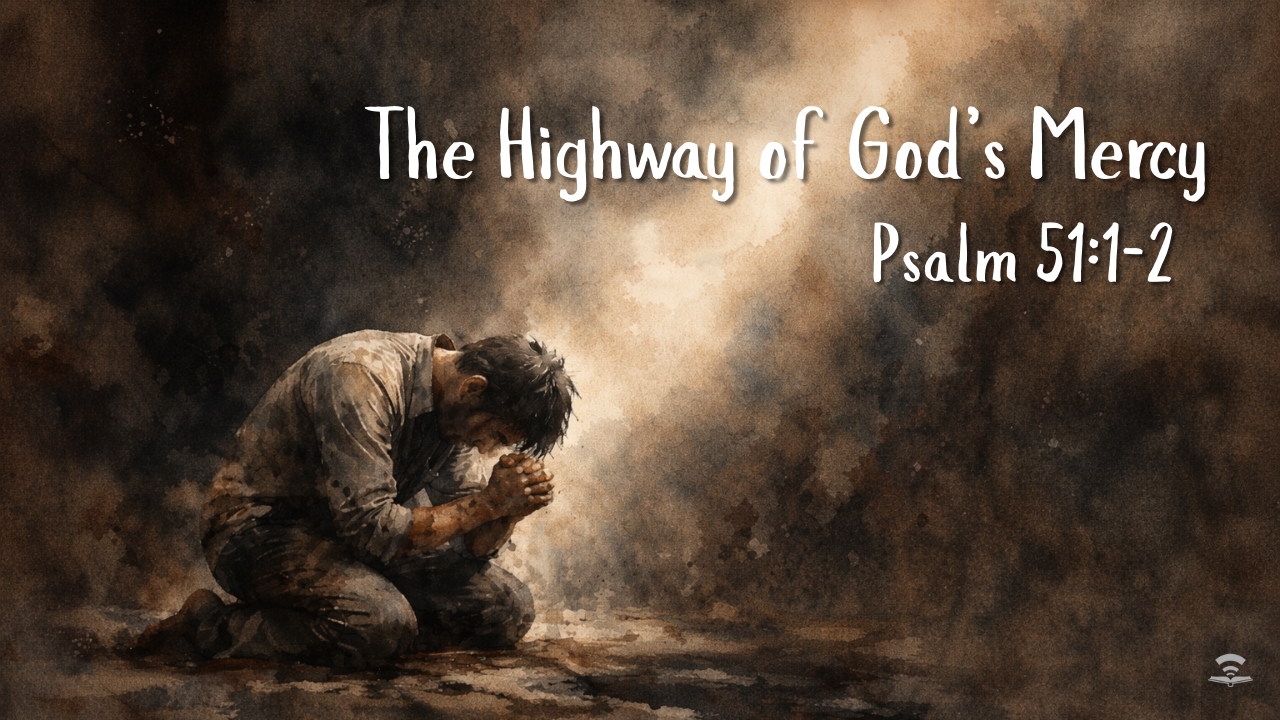
We will turn our Bibles to Psalm 51, Psalm 51 and verses 1 to 3. Verse 1, Have mercy upon me, O God, according to your loving-kindness, according unto the multitude of your tender mercies. Blot out my transgressions. Wash me thoroughly from my iniquity. and cleanse me from my sin, for I acknowledge my transgressions and my sin is ever before me. O Father in heaven, we come to you, Lord God, as we are, knowing how great you are, God, in your mercies towards us. As we thank you, that Lord, there is no love that would not remember the wrongs that we have done, except the love with which you have loved us. In we give you glory, dear Father, for this everlasting love that you have desired and willed, to whom you will be merciful, you will be merciful.
We praise you, dear Father, that our hopelessly lost lives have found mercy in your Son, Lord Jesus. We thank you, dear Father, that your still has clay in your hands. and you the potter is still making us and that you will confirm your glory in us one day and father lord we pray as we carry along in this life father we find your mercy to be always more your grace to be always abounding that you would always find it sufficient Help us, Lord Father, lead us to your presence by your Spirit. And in the enlightening of your Word, you may show us wondrous things. May it lay in our hearts, may it transform us, and may it so encourage us to walk in the boldness and the assurance of Christ Himself. In the name of your Son, Lord Jesus Christ, we ask. Amen.
There's this hymn that we find in the Songs of Zion. Probably we would not sing a hymn like this, but it's a very uh profound hymn in the sense that who wrote it was definitely going through some extremely excruciating pain and sorrow. It's song number 183 and reading it from uh Song Sozine, the first stanza of it, Charles Wesley's hymn, says, Can there be mercy still reserved for me? Yes, can my God His wrath forbear me the chief of sinners' prayer? The third stanza, again extremely critical words. Vents to me this waste of love, ask my Advocate above. It's as if there's somebody up above asking God. Why is such a waste of love shown on me?
The fourth stanza, Therefore me the Saviour stands, Shows His wounds and spreads His hands. God is love, I know I fear. Jesus lives and loves me still. And probably there is always that lingering question, Can God continue to still love? Can God continue to still show mercy? Can such depths of mercy be reserved for me. When we come head-on with our own foolishness and we ponder upon the depravity of our own hearts, we would ponder, can God be truly merciful? And these are some genuine questions that anyone would go through that probably the Lord is frowning over us, He's probably wondering why did He love us, why this waste of love upon... creatures like us.
And these questions are genuine and valid when indeed there is no ground of mercy, there is no basis for God to be merciful. David finds himself in such a position when he has committed adultery and murder and all kinds of sin, he finds himself in that very same straight wondering, will he ever find mercy? What patience would wait as we constantly roam? That's the song which is sang. What kind of patience is this? is still waiting. What father so tenderly is calling us home? Can there still be that mercy? Can God's patience run out after we have constantly day after day roamed?
When our sins and our failures look larger than life, can we come to the throne of God and find more mercy? grace abounding more than our sin, would we still have faith to believe that there is mercy? Or would we resort to other vainful things that depend upon our own selves and wants to prove and pay for our penance? Look at the very first word that David writes down, he says, Have mercy upon me, O God! God is going to be merciful upon David according to what? According to what basis? What foundation? David says, Have mercy upon me, O God, according to your loving-kindness. Which is another word for mercy.
Basically, David is saying, Have mercy according to your mercy. It's like saying, Lord, You have... You have loving-kindness and according to that loving-kindness show me mercy." And then He says, according unto the multitude of Your tender mercies. It's multitude, tender mercies. Another word for mercy. In just one line, David is breathing out, mercy, mercy, mercy. Have mercy according to your loving-kindness, according to the tenderness, according to the multitude of your tender mercies. Well, that's David. He's coming to the presence of God after having most probably lost that baby that was born out of the adultery.
We read how he fasted seven days and then he got up and he started to eat and then came to the temple and that's probably where he's writing this psalm. and it will be important for us today to just go around that mind of David, the mind of a sinner approaching God the Holy One. Because repentance is not about how much we do and what we do as penance for our offence, but it is about our mind. And so to see that heart of David in these three verses will be important for us. How did David describe his sin? How did he put it before the Lord? We see three words there. He first says, blot out my transgressions.
Secondly, he says in two, wash me thoroughly for my iniquity. And thirdly, says, cleanse me from my sin. He uses three words to describe what he has done. First, he says transgressions, then iniquity, and then sin. You can call it the trinity of sin over here. because this describes sin in its totality. The word he used, transgression, he sings, blot out my transgression in its very base meaning, he's saying, blot out my rebellion against you. You see, rebellion is not done out of ignorance. It's not saying that I did it, but I didn't know it was wrong.
Rebellion is a word that shows the strongest form of premeditation, where you are absolutely determined to go against God. And that's the word... David used to describe his sin, it's an outright, outright rebellion that spanned over a year. That he knew it downright in his heart that he is doing wrong and he still would go ahead and do it again and again. He knew adultery was wrong. He knew lying was wrong. He knew covering it up was wrong. He knew the hypocrisy that he wore after doing all of that, that was wrong. And he knew the extent of murder that he had to go to so as to cover his sin, that also was wrong.
And so rightfully he uses the word rebellion because that's exactly what it is. Where he has gone against the very authority and the kingship of who God is. God has an overarching authority over our lives and every sin is a rebellion against that authority saying, I am my own master, I am my Lord and I would do what I want to do with my own life. Whether it be eating of that simple fruit, it was outright rebellion against God. And so David says, blot out that rebellion. The second word he uses there is Iniquity. He says, me thoroughly from my Iniquity.
That's a very interesting piece of word, not just wash me. Wash me thoroughly, as if it is something so sticking, as if it is a very stubborn stain on me. Wash me thoroughly of that Iniquity. What does the word Iniquity mean? It may mean a thing in English, but it's always good to go to this root and it means over there, perverseness. It reflects our heart that is always inclined and perverse to do something that's wrong. In this, David is going down to the very root of his issue, where he recognizes his heart to be pervert or a perverse or out of the way deviant from the very mind of God, and that when he was indulging in that sin, he was thoroughly enjoying it because that is what his heart was, it was perverse.
He recognizes how His heart is filled with iniquity. He says in verse 5, I wash brought forth in iniquity, in sin did my mother conceive me. Where He goes down to the essence of who He is as a person and He finds absolute perversion, depravity, a deviation from the holiness of God. And He's saying, Lord, wash that perversion away. It's in me. It sticks so strongly. It's my ready inclination every day. It's my inclination to always go against you. It's as if my code and my DNA to do things against you. And to take something out like that that is so intricate, so inherent in us, requires intense washing, like he would say, wash me thoroughly.
Lastly, he would use the word sin. Cleanse me from my sin. It is the word used for offence. where there is now a record of what He has done and He is now bearing its guilt and its offence day in and out. You see, when we would probably confess our sins, we would more and more concentrate on the offence of it, of the act of it, of what we eventually did in that sin. David doesn't leave that part out, but his confession is so wholesome. He talks of his perversion. He talks of his rebellion. And yes, then he also talks of the offense he did, the act he did.
It is not the act that makes it sinful. It's the very thought of it, the very perversion of our heart and the thought of rebellion that eventually brings forth its fruit as an offense. And so David does this one thing so beautifully right. No excuses, with no mitigating circumstances to make his offense look smaller. No passing off of offence to people around him. No blaming of his past of how he was brought up. He goes down to the root of who he is. He calls himself a pervert. He calls himself a rebel. He calls himself a sinner. And such a person comes before God.
Now can he ever find mercy? He begins by saying, have mercy upon me, O God. This is a very interesting word that he uses there. have mercy upon me, God. The very first time this word appears in the Bible is in a situation where Jacob meets Esau and Esau is asking Jacob, who are these with you? And Jacob answers saying these are the children that God has given your servant because God has been merciful. Interestingly, eventually Ironically, would say David also had a baby out of this relationship and it was clearly told him that you're gonna lose it and David then decides to go into abstinence for seven days where he eats and drinks nothing.
and after the baby is lost he gets up starts eating and he's puzzled everyone around him and so they ask him what kind of behavior is this when you're child was there, you were fasting, when your child is dead, you start eating and drinking. And David uses the same word again to explain that behaviour. He says, who can tell that God may be merciful? That, in a way, that question that David is asking, who can tell, shows the very mysterious aspect of God's mercy. Yes, God has determined that He is going to lose that baby, but who can tell that God may be merciful?
You see, we had the whole scriptures with us to understand God's mercy, but David just had as much as he could, and in that little knowledge that he had, he understood God's mercy like this, that despite God Himself pronouncing the judgment, probably, there is still a chance that God could be merciful. That He did not take God's word at His that if He's going to lose the baby, then He's going to lose the baby. He didn't take it at it. He fasted seven days. pleading for God's mercy on the child.
That even if God has determined that there will be consequence and there will be judgment, but who can tell in the midst of that consequences, God will be merciful. And if it requires that David has to fast seven days to get that mercy, he would do that, because that's the word mercy over here. The word mercy actually gives us an impression of a neck that is... bending down of a extremely exalted, majestic one, bending down towards someone inferior. And look at that hope of David. Against a written judgment, against the surety of God's judgment, David knows God enough to know that God can still be merciful.
And so when David comes after having lost his child, when he comes now to plead for his own self, he's still holding to that nation of God. He's still holding to that mystery of God's mercy. He's still holding on to that unknown, bottomless depths of God's mercy that no one knows. And holding on to that, He's asking and pleading, Lord, with that mercy, that bottomless, that patience that always waits, that love that always calls, let that mercy be for me. Now on what basis? So He uses the word according or as per as if He wants to go back to the... past, he wants to go back to the precedence of how God has always been merciful.
And so he uses another word for mercy which in our translations may be different but it's another word for mercy. He says loving kindness. So it is Anugra have mercy Karuna ke nusaar. So the word there is loving kindness. Yeah, we have these different words but the original language is so rich that uh it gives different meanings each time different word is used. He says over here, according to your loving-kindness, and the word there is used is actually the word that eventually gets translated in New Testament for grace.
And very often in the Old Testament, whenever this word appears, it always appears with the word uh truth or faithfulness. According to... your loving-kindness and truth. That is how this word always goes together and it appears together quite often that way. And that's the same word that John uses to talk of Christ, the One who came of God, the Father, filled with the glory, a glory full of grace and truth. It's the same word where always this word is associated with the truthfulness, the faithfulness of who God is. So on what basis should God be merciful?
He should be merciful on the basis of His mercy that flows out of His covenant of truth and faithfulness. There is a mercy that God shows just because He is truthful. There is a mercy that God shows just because He is faithful. There is a mercy that God shows just because He has made a covenant with Abraham, Isaac and Jacob and for that covenant shake, He will always be merciful to them and their children. And this reflects to that surety of God's mercy that there is always a mercy that God will show because of His covenant.
He has entered into a covenant with Abraham, with Isaac, with Jacob, with Moses, with Israel, with us through His Son and because of that covenant there will and always surely be that mercy. In fact, this is what the Lord told David that, will raise up a son who will build a temple and if he sins and if he chastens, I will correct him. But I will never take away this mercy from Him. That He could turn out to be how great or what has He wants to be, this mercy, I will never take it away from Him.
This is the mercy that God displayed to Moses when Moses told me, Show me your face. And this is the mercy that is always described in the scriptures to be abundant. When they had sinned and the Lord was determined to finish them off and make of Moses a new race, This is the mercy that Moses called upon, the abundant mercy of God, and says, Lord, that You are abundant in Your mercies. And so David armed with this knowledge, with the precedence of how God has always been merciful in the past, with the precedence of how God will never fail His covenant irrespective of the other side being a failure.
So he comes to God and says, Lord, have mercy upon me according to that covenantal mercy. But he doesn't stop there. He says once more, according to... Yes, according to the multitude of your tender mercies. Yes, again that word is so not captured in English or in Hindi, but the word there is womb or compassion or bowels of compassion. It's like a baby that's wrapped in the mother's womb, the most secure, the most warmth the baby would ever feel. And that imagery is used to describe mercy. It is the greatest expression of God's mercy.
That's why in English they put the word tender. It tries to show the exceeding empathy that God has towards sinners. And David again falls back to the scriptures and says, Lord, You have so much of it! You have a multitude of that tender mercies! Much later on in life, David again commits a sin. He counts the people when he should not have. And in response to that, there were three options given to him. The Lord told you can have three years of famine or you could have three months of sword of the man, that is, sword of your enemies pursuing you and destroying you.
or you could have three days of God's sword and God's pestilence upon you. Now that's a very difficult choice to make. If we were to just look at the three options, it's difficult to even understand which is more severe than the other, that which will actually be more less destructive than the others. So what did David select? He selected the fourth option that was always there. He says, I will fall into the hands of the Lord, for He is very great in this mercy. And so then the punishment started. The Lord sent the sword, the Lord sent the pestilence, uh enormous amount of people died.
But David was right. God is so very great in mercy! If God's Holiness truly demanded three full days of pestilence and sword, destroying the land of Israel or if it required three full months of enemies pursuing them or if it required three full years of famine either ways this is all too much for God to destroy because if God has to truly bring about the full end of us for our sins he doesn't need even three days one day one moment one second of his wrath would be too much for us to bear.
that it wouldn't need even more than that moment for us to be destroyed And so if the Lord took three days or even if He took one day where He killed and He sent pestilence, it was God working in hyper slow mode in pouring out His wrath. And it's written there where the Lord looked at the destruction and He relented as if He told the angel, He said, it is enough. He literally told the angel, it is enough. Three days are not even done. Probably the same day where the Lord is saying, hold back, God... was just in His wrath, but David was bang on about God's mercy.
It is so very great! God will not relent and protect His children from the very consequence of the sin that they have committed. But David knew from the scriptures that God has said, I will not make a fool end of you, where when it comes to His wrath, He will always remember His mercy. And He has never seen through His wrath with anybody. If at all He has ever done that, it is with His own Son, where at the cross, instead of saying it is enough, the Son said it is finished, where He bore all wrath.
And so when the Lord tries us because of our sins and because of our consequences, there is always a point where the Lord will say, sufficient for that man is the sorrow thereof. And so it is with this boldness we come to God knowing there is always, always, Mercy reserved for the Chief of Sinners. God's name be glorified.
We praise you, dear Father, that our hopelessly lost lives have found mercy in your Son, Lord Jesus. We thank you, dear Father, that your still has clay in your hands. and you the potter is still making us and that you will confirm your glory in us one day and father lord we pray as we carry along in this life father we find your mercy to be always more your grace to be always abounding that you would always find it sufficient Help us, Lord Father, lead us to your presence by your Spirit. And in the enlightening of your Word, you may show us wondrous things. May it lay in our hearts, may it transform us, and may it so encourage us to walk in the boldness and the assurance of Christ Himself. In the name of your Son, Lord Jesus Christ, we ask. Amen.
There's this hymn that we find in the Songs of Zion. Probably we would not sing a hymn like this, but it's a very uh profound hymn in the sense that who wrote it was definitely going through some extremely excruciating pain and sorrow. It's song number 183 and reading it from uh Song Sozine, the first stanza of it, Charles Wesley's hymn, says, Can there be mercy still reserved for me? Yes, can my God His wrath forbear me the chief of sinners' prayer? The third stanza, again extremely critical words. Vents to me this waste of love, ask my Advocate above. It's as if there's somebody up above asking God. Why is such a waste of love shown on me?
The fourth stanza, Therefore me the Saviour stands, Shows His wounds and spreads His hands. God is love, I know I fear. Jesus lives and loves me still. And probably there is always that lingering question, Can God continue to still love? Can God continue to still show mercy? Can such depths of mercy be reserved for me. When we come head-on with our own foolishness and we ponder upon the depravity of our own hearts, we would ponder, can God be truly merciful? And these are some genuine questions that anyone would go through that probably the Lord is frowning over us, He's probably wondering why did He love us, why this waste of love upon... creatures like us.
And these questions are genuine and valid when indeed there is no ground of mercy, there is no basis for God to be merciful. David finds himself in such a position when he has committed adultery and murder and all kinds of sin, he finds himself in that very same straight wondering, will he ever find mercy? What patience would wait as we constantly roam? That's the song which is sang. What kind of patience is this? is still waiting. What father so tenderly is calling us home? Can there still be that mercy? Can God's patience run out after we have constantly day after day roamed?
When our sins and our failures look larger than life, can we come to the throne of God and find more mercy? grace abounding more than our sin, would we still have faith to believe that there is mercy? Or would we resort to other vainful things that depend upon our own selves and wants to prove and pay for our penance? Look at the very first word that David writes down, he says, Have mercy upon me, O God! God is going to be merciful upon David according to what? According to what basis? What foundation? David says, Have mercy upon me, O God, according to your loving-kindness. Which is another word for mercy.
Basically, David is saying, Have mercy according to your mercy. It's like saying, Lord, You have... You have loving-kindness and according to that loving-kindness show me mercy." And then He says, according unto the multitude of Your tender mercies. It's multitude, tender mercies. Another word for mercy. In just one line, David is breathing out, mercy, mercy, mercy. Have mercy according to your loving-kindness, according to the tenderness, according to the multitude of your tender mercies. Well, that's David. He's coming to the presence of God after having most probably lost that baby that was born out of the adultery.
We read how he fasted seven days and then he got up and he started to eat and then came to the temple and that's probably where he's writing this psalm. and it will be important for us today to just go around that mind of David, the mind of a sinner approaching God the Holy One. Because repentance is not about how much we do and what we do as penance for our offence, but it is about our mind. And so to see that heart of David in these three verses will be important for us. How did David describe his sin? How did he put it before the Lord? We see three words there. He first says, blot out my transgressions.
Secondly, he says in two, wash me thoroughly for my iniquity. And thirdly, says, cleanse me from my sin. He uses three words to describe what he has done. First, he says transgressions, then iniquity, and then sin. You can call it the trinity of sin over here. because this describes sin in its totality. The word he used, transgression, he sings, blot out my transgression in its very base meaning, he's saying, blot out my rebellion against you. You see, rebellion is not done out of ignorance. It's not saying that I did it, but I didn't know it was wrong.
Rebellion is a word that shows the strongest form of premeditation, where you are absolutely determined to go against God. And that's the word... David used to describe his sin, it's an outright, outright rebellion that spanned over a year. That he knew it downright in his heart that he is doing wrong and he still would go ahead and do it again and again. He knew adultery was wrong. He knew lying was wrong. He knew covering it up was wrong. He knew the hypocrisy that he wore after doing all of that, that was wrong. And he knew the extent of murder that he had to go to so as to cover his sin, that also was wrong.
And so rightfully he uses the word rebellion because that's exactly what it is. Where he has gone against the very authority and the kingship of who God is. God has an overarching authority over our lives and every sin is a rebellion against that authority saying, I am my own master, I am my Lord and I would do what I want to do with my own life. Whether it be eating of that simple fruit, it was outright rebellion against God. And so David says, blot out that rebellion. The second word he uses there is Iniquity. He says, me thoroughly from my Iniquity.
That's a very interesting piece of word, not just wash me. Wash me thoroughly, as if it is something so sticking, as if it is a very stubborn stain on me. Wash me thoroughly of that Iniquity. What does the word Iniquity mean? It may mean a thing in English, but it's always good to go to this root and it means over there, perverseness. It reflects our heart that is always inclined and perverse to do something that's wrong. In this, David is going down to the very root of his issue, where he recognizes his heart to be pervert or a perverse or out of the way deviant from the very mind of God, and that when he was indulging in that sin, he was thoroughly enjoying it because that is what his heart was, it was perverse.
He recognizes how His heart is filled with iniquity. He says in verse 5, I wash brought forth in iniquity, in sin did my mother conceive me. Where He goes down to the essence of who He is as a person and He finds absolute perversion, depravity, a deviation from the holiness of God. And He's saying, Lord, wash that perversion away. It's in me. It sticks so strongly. It's my ready inclination every day. It's my inclination to always go against you. It's as if my code and my DNA to do things against you. And to take something out like that that is so intricate, so inherent in us, requires intense washing, like he would say, wash me thoroughly.
Lastly, he would use the word sin. Cleanse me from my sin. It is the word used for offence. where there is now a record of what He has done and He is now bearing its guilt and its offence day in and out. You see, when we would probably confess our sins, we would more and more concentrate on the offence of it, of the act of it, of what we eventually did in that sin. David doesn't leave that part out, but his confession is so wholesome. He talks of his perversion. He talks of his rebellion. And yes, then he also talks of the offense he did, the act he did.
It is not the act that makes it sinful. It's the very thought of it, the very perversion of our heart and the thought of rebellion that eventually brings forth its fruit as an offense. And so David does this one thing so beautifully right. No excuses, with no mitigating circumstances to make his offense look smaller. No passing off of offence to people around him. No blaming of his past of how he was brought up. He goes down to the root of who he is. He calls himself a pervert. He calls himself a rebel. He calls himself a sinner. And such a person comes before God.
Now can he ever find mercy? He begins by saying, have mercy upon me, O God. This is a very interesting word that he uses there. have mercy upon me, God. The very first time this word appears in the Bible is in a situation where Jacob meets Esau and Esau is asking Jacob, who are these with you? And Jacob answers saying these are the children that God has given your servant because God has been merciful. Interestingly, eventually Ironically, would say David also had a baby out of this relationship and it was clearly told him that you're gonna lose it and David then decides to go into abstinence for seven days where he eats and drinks nothing.
and after the baby is lost he gets up starts eating and he's puzzled everyone around him and so they ask him what kind of behavior is this when you're child was there, you were fasting, when your child is dead, you start eating and drinking. And David uses the same word again to explain that behaviour. He says, who can tell that God may be merciful? That, in a way, that question that David is asking, who can tell, shows the very mysterious aspect of God's mercy. Yes, God has determined that He is going to lose that baby, but who can tell that God may be merciful?
You see, we had the whole scriptures with us to understand God's mercy, but David just had as much as he could, and in that little knowledge that he had, he understood God's mercy like this, that despite God Himself pronouncing the judgment, probably, there is still a chance that God could be merciful. That He did not take God's word at His that if He's going to lose the baby, then He's going to lose the baby. He didn't take it at it. He fasted seven days. pleading for God's mercy on the child.
That even if God has determined that there will be consequence and there will be judgment, but who can tell in the midst of that consequences, God will be merciful. And if it requires that David has to fast seven days to get that mercy, he would do that, because that's the word mercy over here. The word mercy actually gives us an impression of a neck that is... bending down of a extremely exalted, majestic one, bending down towards someone inferior. And look at that hope of David. Against a written judgment, against the surety of God's judgment, David knows God enough to know that God can still be merciful.
And so when David comes after having lost his child, when he comes now to plead for his own self, he's still holding to that nation of God. He's still holding to that mystery of God's mercy. He's still holding on to that unknown, bottomless depths of God's mercy that no one knows. And holding on to that, He's asking and pleading, Lord, with that mercy, that bottomless, that patience that always waits, that love that always calls, let that mercy be for me. Now on what basis? So He uses the word according or as per as if He wants to go back to the... past, he wants to go back to the precedence of how God has always been merciful.
And so he uses another word for mercy which in our translations may be different but it's another word for mercy. He says loving kindness. So it is Anugra have mercy Karuna ke nusaar. So the word there is loving kindness. Yeah, we have these different words but the original language is so rich that uh it gives different meanings each time different word is used. He says over here, according to your loving-kindness, and the word there is used is actually the word that eventually gets translated in New Testament for grace.
And very often in the Old Testament, whenever this word appears, it always appears with the word uh truth or faithfulness. According to... your loving-kindness and truth. That is how this word always goes together and it appears together quite often that way. And that's the same word that John uses to talk of Christ, the One who came of God, the Father, filled with the glory, a glory full of grace and truth. It's the same word where always this word is associated with the truthfulness, the faithfulness of who God is. So on what basis should God be merciful?
He should be merciful on the basis of His mercy that flows out of His covenant of truth and faithfulness. There is a mercy that God shows just because He is truthful. There is a mercy that God shows just because He is faithful. There is a mercy that God shows just because He has made a covenant with Abraham, Isaac and Jacob and for that covenant shake, He will always be merciful to them and their children. And this reflects to that surety of God's mercy that there is always a mercy that God will show because of His covenant.
He has entered into a covenant with Abraham, with Isaac, with Jacob, with Moses, with Israel, with us through His Son and because of that covenant there will and always surely be that mercy. In fact, this is what the Lord told David that, will raise up a son who will build a temple and if he sins and if he chastens, I will correct him. But I will never take away this mercy from Him. That He could turn out to be how great or what has He wants to be, this mercy, I will never take it away from Him.
This is the mercy that God displayed to Moses when Moses told me, Show me your face. And this is the mercy that is always described in the scriptures to be abundant. When they had sinned and the Lord was determined to finish them off and make of Moses a new race, This is the mercy that Moses called upon, the abundant mercy of God, and says, Lord, that You are abundant in Your mercies. And so David armed with this knowledge, with the precedence of how God has always been merciful in the past, with the precedence of how God will never fail His covenant irrespective of the other side being a failure.
So he comes to God and says, Lord, have mercy upon me according to that covenantal mercy. But he doesn't stop there. He says once more, according to... Yes, according to the multitude of your tender mercies. Yes, again that word is so not captured in English or in Hindi, but the word there is womb or compassion or bowels of compassion. It's like a baby that's wrapped in the mother's womb, the most secure, the most warmth the baby would ever feel. And that imagery is used to describe mercy. It is the greatest expression of God's mercy.
That's why in English they put the word tender. It tries to show the exceeding empathy that God has towards sinners. And David again falls back to the scriptures and says, Lord, You have so much of it! You have a multitude of that tender mercies! Much later on in life, David again commits a sin. He counts the people when he should not have. And in response to that, there were three options given to him. The Lord told you can have three years of famine or you could have three months of sword of the man, that is, sword of your enemies pursuing you and destroying you.
or you could have three days of God's sword and God's pestilence upon you. Now that's a very difficult choice to make. If we were to just look at the three options, it's difficult to even understand which is more severe than the other, that which will actually be more less destructive than the others. So what did David select? He selected the fourth option that was always there. He says, I will fall into the hands of the Lord, for He is very great in this mercy. And so then the punishment started. The Lord sent the sword, the Lord sent the pestilence, uh enormous amount of people died.
But David was right. God is so very great in mercy! If God's Holiness truly demanded three full days of pestilence and sword, destroying the land of Israel or if it required three full months of enemies pursuing them or if it required three full years of famine either ways this is all too much for God to destroy because if God has to truly bring about the full end of us for our sins he doesn't need even three days one day one moment one second of his wrath would be too much for us to bear.
that it wouldn't need even more than that moment for us to be destroyed And so if the Lord took three days or even if He took one day where He killed and He sent pestilence, it was God working in hyper slow mode in pouring out His wrath. And it's written there where the Lord looked at the destruction and He relented as if He told the angel, He said, it is enough. He literally told the angel, it is enough. Three days are not even done. Probably the same day where the Lord is saying, hold back, God... was just in His wrath, but David was bang on about God's mercy.
It is so very great! God will not relent and protect His children from the very consequence of the sin that they have committed. But David knew from the scriptures that God has said, I will not make a fool end of you, where when it comes to His wrath, He will always remember His mercy. And He has never seen through His wrath with anybody. If at all He has ever done that, it is with His own Son, where at the cross, instead of saying it is enough, the Son said it is finished, where He bore all wrath.
And so when the Lord tries us because of our sins and because of our consequences, there is always a point where the Lord will say, sufficient for that man is the sorrow thereof. And so it is with this boldness we come to God knowing there is always, always, Mercy reserved for the Chief of Sinners. God's name be glorified.

Podcast: Play in new window | Download
Subscribe: Apple Podcasts | Spotify | RSS