
Listen to complete sermon series: Psalm 51
Sermon Transcript
Psalm 51 and verses 7 through 12: Purge me with Hyssop and I shall be clean. Wash me and I shall be whiter than snow. Make me to hear joy and gladness that the bones which you have broken may rejoice. Hide your face from my sins and blot out all my inequities.
Create in me a clean heart, O God, and renew a right spirit within me. Cast me not away from your presence, and take not your Holy Spirit from me. Restore unto me the joy of your salvation, and uphold me with your generous Spirit.
We've been considering for a while Psalm 51 and we have seen verses 1 through 6 so far. The first three verses we could have titled it as the Highway of Mercy because after David had done those abominable sins, the only thing he could cling for is abundance and abundance of God's mercy. And so he explains for us what is those multitudes of mercy, what are those reasons for why God can still be merciful despite a sin like this. But that highway of mercy should lead to a point, to a logical conclusion.
Mercy is God's responsibility, God's Oneness, God's part, but then that all of mercy should lead to a reasonable response from us. It would be practically useless if we just harp about God's mercy but forget our own responsibility towards it. So that highway of mercy we saw in the next three verses, verses 3 to 6, leads to a pit-stop of repentance. It would be useless if God is only merciful, but the sinner is never repentant. And so the extent to which David repents of his sin, the depths to which he repents, is what we considered in the last time.
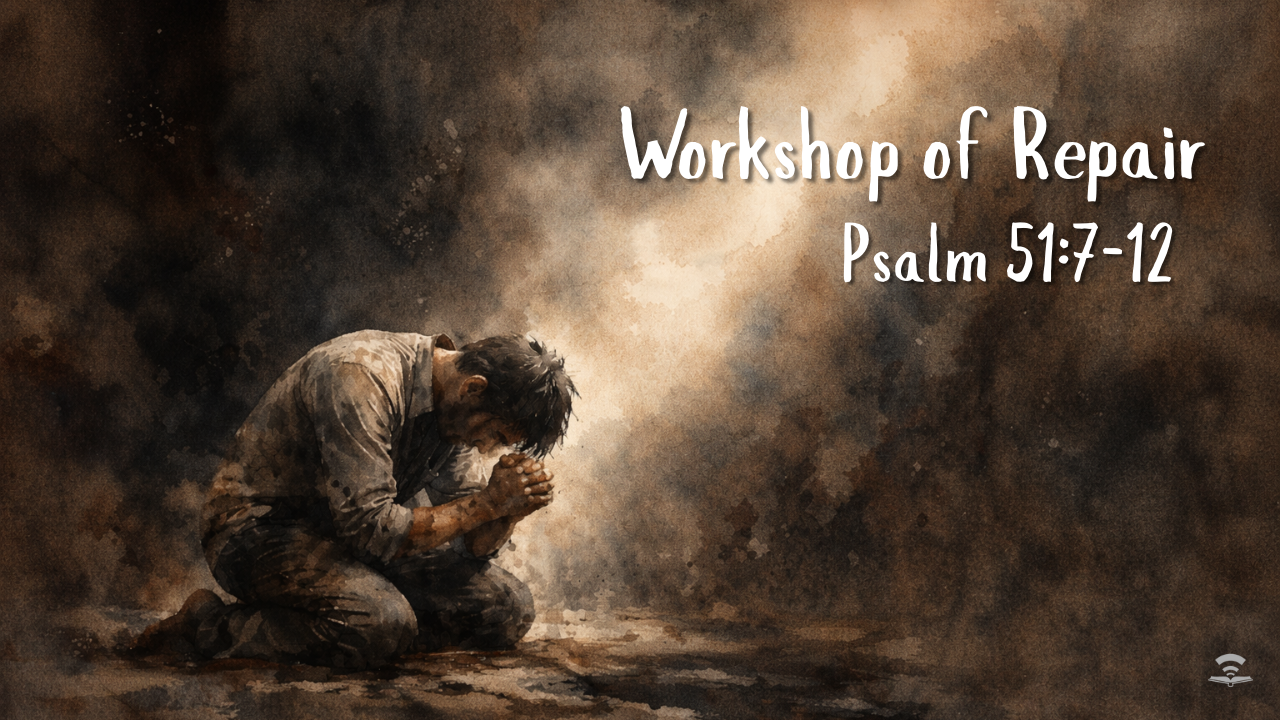
But then repentance in itself is not the complete story. So now we consider verses 7 through 12, where we will consider the workshop of repair, which is what a sinner truly desires. You see how useless mercy is without repentance and how useless repentance is if there is no repair and restoration. And so we pray that as we consider these six verses, it would be a cause for our own repair and restoration. I want to start by saying let's take a minute to read these six verses by ourselves and try to count the number of requests that David is making.
Let's put a count, the number of requests that David is asking. How many things is the Lord been asked of? 12, yeah, I think the maximum we can get to is 12. And if you take that number, 12, you're talking of 12 requests in a matter of six verses. It's like David is going on full speed, full stern ahead, one after the other. One statement itself has two requests. One after the other, he's filling these few verses with so many requests. 7: Purge me and then wash me. Make me to hear joy and my bones would rejoice. Hide your face and blot out my inequities. Create in me, renew a right spirit. Cast me not away and take not your Holy Spirit. Restore unto me and uphold me.
So many requests in a matter of just six verses. But let's look into it a bit more closer that though there are so many requests, there is no doubt repetitions in these requests. In fact, it is in 12, it is just three things being repeated twice and each time he repeats it, he repeats it twice. So you see a couplet being formed between the first three verses and the next three verses. For example, verse 7 goes well with verse 10. Because in both of this, he is talking of himself, what needs to change in himself.
Similarly, we could join verse 8 with verse 12, where He's now talking of the joy that He wants or the fellowship that He wants with God. Lastly, verse 9, it says, where He's talking now of the escape that He wants, of the impending judgment, joins with verse 11. And so here we have formed couplets. David is basically asking three things, twice he asks it, and each time he's asking there are two requests in it. And that's where we have just six verses filled with 12 requests. But if you look at this triangle of requests, three main things that David is requesting, you see how complete the restoration that he wants for himself.
You see, we struggle to understand what is restoration of sin because at the very basic we find it challenging to understand how much we have sinned. If you have fallen just a few steps, it's easy to climb it up. But if you have fallen from the very glory of God, can we put a limit? Can we even understand how much will it take of us to restore ourselves back to God? If we have to even consider the depths to which we have fallen, we have to first consider the glory from which we have fallen. It is that high standards from which we have fallen. And if it is such great a fall, then imagine what will it take us to restore ourselves back.
You see, that's how complicated and that's how difficult is full restoration. And it's not just mere restoration unto God, but also dealing with the fallout or the consequences of your own sins. After committing adultery, after committing deceit, after committing murder, can there be a normal that David can return to? Can he come back to where he left off? Can he untangle every single complicated knot he has got for himself? Can it be a straight rope again? If so, up to what extent? You see, it's far more difficult, far more challenging than just merely asking, Lord, forgive me.
Where true restoration involves so many aspects, where the task is such a great task, it's an uphill task. And the last thing we would want of ourselves after having seen these six verses is to think that this is what we need to do, because it's impossible to do this. And that's not the lesson or the conclusion of this passage where we look at these twelve things and now think, okay, these are the 12 things we need to do. It is impossible to do even one. And these 12 things are listed down for us not because in a way to motivate us to restore ourselves, to repair ourselves, because it's impossible to do these things.
Let's remind ourselves this is a prayer. The most we can do, the most we should be doing, is to pray a prayer like faith, like this, that we come to God as humbled as David is and pray it out. That it is impossible to do the things that are required of us to see full restoration. It's more than just being clean. It's more than just being made holy. It's more than just escaping the judgments of God. It's like how we just sang, plunge in today and be made complete, where restoration should be complete. And so it is so critical that the Lord does not stop at just mere sending His Son to the cross. There is so much more when it comes to our restoration.
You see there are these three things that makes restoration complete. Let's read verse 7. The first thing that David wants to look in the matter of restoration is his own self. Purge me, wash me. Where self needs to be transformed. Where God, if He has to start working on restoration, He will first start on our own selves. Circumstances come later on. Judgments and escapes of it come later on. The first and foremost, what is required is for God to work on ourselves. And this follows the previous two verse where David has said, I am a sinner from conception. Right from my mother's womb, when I was day one conceived, I was a sinner.
And not just merely I am a sinner, but I have failed to imbibe God's Word in me. Truth of God is not found in my inwards part. So I have made my desperate condition all the more desperate. So my heart has never steadfast before God. It's desperately wicked and deceitful above all things. It's the best explanation to give for all the kind of madness I have done. Whatever sins I have done, whatever be the extent of rebellion, it has started with my own self. Not the circumstances, not the favourable opportunities. I did it because I wanted it. It's my own heart's desire that needs to be fixed.
So, David says, first and foremost, purge me with hyssop. The word hyssop should take us back to the Old Testament. There are particularly instances in the law of Moses where this thing is used. For example, when a leper comes before the priest in the ceremony of his cleansing, this hyssop is used. And then for example, a person who is unclean by touching a dead person, a person who has become unclean because of someone dead in his own home, he comes to a priest for cleansing and again hyssop is used. But hyssop is just an instrument. Question is, what is the cleansing agent?
The underlying assumption is in all of those ceremonies when the hyssop is used, there is blood. Where the priest will sprinkle blood probably with this same hyssop. You see, that's a very significant thing for the priest to do. It isn't enough just for the leper to be healed of his leprosy on the outside. He may be completely germ-free. But the Lord told the lepers, go and show yourself to the priest. There is a ceremonial cleansing as much as important as the physical cleansing, where there is a necessity for a sacrifice for a bird to be killed and a bird to be drenched in the blood of the killed bird and then let go and freeze.
There is a necessity for blood to make a leper clean. Similarly, a person who has touched the dead body, he can wash himself, he can quarantine himself, all of that is required of him, but still at the end of that process, he needs to come and be cleansed ceremonially. And probably David, when he's writing this Psalm, he's at the temple and he's looking at these things and he's asking Lord, just like you make that leper clean, cleanse me of my leprosy with hyssop and He has a correct view of Himself. He sees Himself like a leper. That you can probably be healed of leprosy, still before God it is required that God pronounces you clean.
You can be clean of all kinds of pathogens and germs after touching a dead body, but still before God it is required that God declares you clean. And this is the first step in restoration where God needs to purge us, cleanse us of our unrighteousness in us, purge me and wash me. It talks of all the old things that needs to go away. It talks of all the deceptive, crooked heart of ours that needs to go away. It talks of the old man that needs to be mortified and crucified. It talks about that hard-hearted stone-like heart that needs to go away.
When David sees himself, he sees a person like a leper in want of a fix and we are extremely dirty as far as sin is concerned. There are no depths to which our heart can truly fall. There are no limits to which we can fill our heart with the things that defile us. Sometimes if we were to just consider how much a cleansing God has to clean ourselves with. But you see, just the old going away isn't sufficient. So when we come to the second part of that couplet in verse 10, now David progresses and he says, now Lord, You create in me a clean heart and renew a right spirit, a steadfast spirit within me.
Just as much as the old should go away, God should bring in a new. Just as much as a deceitful heart should go away, God should establish in us a new heart, a renewed spirit. Just like an old man should be crucified, God should renew in us a new creation. We're reading this thousand years before Christ actually came down and we're actually seeing the whole gospel in work over here. David, being led by the Spirit, is praying the right things. You see how incomplete it is just if we take a bath? How incomplete it is if just our stains are washed away?
The Lord talks of a person, a parable, a man who was possessed with a demon. And the demon, for a season, left that man and he was roaming around and he did not get a place to rest, so he comes back to his first host. But when he came back to his first host, he found that the heart is extremely well done, fully cleaned, well neat and disciplined. So what does he do? He goes and gets seven other demons and they all now come in to this one person. This one parable talks of the dangers of incomplete restoration.
For when that person got that season, that season when the demon did not oppress him, He tried to get his life in order, he set his heart in order, he made it clean, he made it neat, he became the Lord of it. It was insufficient though for him to just take out things that are unclean out of his heart, but was necessary for him to make the Lord the Lord of his heart. The story would have been completely different when the demon having come back would have found the Holy Spirit abiding in him. And that's the mistake that we all do in this world.
We try to be a better you, better my, better I self, better of our own version, forgetting that it isn't just about ourselves, we need to be made new, completely new. Where when we come to God, we don't promise God, Lord, I'll be better than last time, no. We are asking Lord, Lord, make us new, create in me a new heart. But you see, just the change of our own selves is not going to be sufficient. There is something more that David is now asking. So we come to the second thing in verse 8. He says, make me to hear joy and gladness, that the bones which you have broken may rejoice.
He's asking to hear joy and gladness. He's asking that his broken bones should rejoice. What is David now asking? He's asked for a new heart, he's asked for a new person, but there is something more to restoration. What about the consequences of his sin that he has to deal with? What about his spiritual apathy? What about his fellowship with God? What about the despondency and sorrows and sadness that he is in? You see, you can look at this in so many different ways. But in nutshell, he is asking for joy. Make me to hear joy. My bones that are broken should rejoice.
And then in the couplet verse 12, restore unto me the joy of salvation. It's all about being joyful in the Lord. It's all about being restored in fellowship with God. And how does that start? David says, make me to hear, make me to hear joy and gladness. And where else can such words of joy and gladness be found except it be the good news of God. He's asking for the gospel. He's asking for some good news. I want to hear something that makes me happy. He talks of his bones being broken, probably not literally but definitely his sin had some repercussions in his body or some repercussions in his life.
He's lost his son, four times more the Lord is going to deal with him, and innumerable judgments are going to befall him, it's going to break his bones like anything, and He's not asking, Lord, You join those bones. In those broken bones, let me rejoice. I have fallen, I find myself in desperate conditions, I am facing unsurmountable consequences, but in the midst of all my undoing, let me just hear joy. How many desperate hearts today just want to hear the good news? Hearts that are saddened and depressed and valuing in their sin, just waiting for one word of joy and gladness.
Like those two disciples going on the way of Emmaus, just weeping over a crucified Lord and the Lord comes along and gives them the word which burns their heart with joy. This one request or it signifies or emphasizes the importance of God's Word and Restoration. Sometimes we may not have Nathan to come along or the Lord Jesus to come along, we don't have a person to come along, but we have the scriptures in us and the very Spirit in us to make us hear joy and gladness. This Word of joy and gladness is not too far away from us.
We don't live in those times of dearth and famine. We have so much of God's Word that it is only this word that can repair a bruised heart, that can heal a wounded heart. And so David is asking, Lord, just make me hear some good news. But it doesn't stop there. In the next couplet in verse 12, the joining verse, he says, restore unto me the joy of salvation. You see, there was a point in time when David took joy and pleasures in the sinfulness of this world. He took pleasures in the cheap things of this world.
And sometimes we make ourselves a big fool when we sell off the great joys of salvation for the very cheap sins of this world. They're literally short-shouldered when we go for pig's food, when there is joy and pleasures evermore at the right hand of God. David finds himself in a depressing condition where he is now lacking joy and he associates that joy with salvation. He's not asking, Lord, You restore unto me salvation because it hasn't been lost, but there is a joy of salvation, the rejoicing of it, the pleasures of it that He no longer enjoys, that it is the natural outcome of an assured believer that He will rejoice.
Like in Psalm 35:9, the Psalmist says, My soul shall be joyful in the Lord, it shall rejoice in His salvation. To just rejoice in the salvation that God has provided. These are true gospel words of joy and gladness that a sinner wants. So what does a sinner want? He wants himself to be transformed. He wants himself to be restored in full fellowship, in full joy and pleasure unto the Lord. But there's a third thing that completes restoration and that's a requirement of God Himself. In verse 9, David is now praying, hide your face from my sins and blot out all my inequities.
Yeah, he's asking for his self to be transformed. He's asking himself to be restored in full fellowship unto God. He is careful in not asking his consequences to go away. He's asking that he should rejoice in whatever be the consequences. But then the question is at what cost? Who's going to pay for it? What about the question of judgment? Who's going to deal with the very act and the offence of sin which is always before the Lord? So David begins by saying, Lord, you hide your face and that's in reference to the word atonement.
Because atonement is a mere covering, it's a blood that is poured just to cover the sin, the sin is still there, it is covering the sin. But then David soon realizes that this is insufficient, it isn't just sufficient that the Lord just hide his face, it would be far better if those sins are blotted away, that there should be no remembrance of it, no mention of it, no record of it, it should be just taken away. And if it isn't just merely the sins being taken away but the underlying request is the associated judgments that is supposed to befall Him.
So in the couplet in verse 11, He says, cast me not away from your presence and take not your Holy Spirit from me. This is the best description to explain what is God's judgment against sin. What does judgment against sin entail? It's given in this. When the Lord tells the sinners in that final day of judgment, go away from me you workers of inequity, He will be sending them to the lake of fire, but signifying these two things, they are cast away from His presence and His Spirit no longer strives with them. Eternal separation is the only cost of every sin.
You can pray for yourself to be better, you can pray for a new heart, you can pray for a restored joy and fellowship, but all of this is only possible when God makes a payment, a price, for that judgment to go away. You see, this is how God completely restores a sinner. So as to not just merely hide His face but even blot out our sins, He sent His Son. And so as to not for us to go away from God's presence or the Holy Spirit to be taken away from us, His Son on the Cross experience eternal damnation and separation that only God and sinners should experience.
And so it's in the basis of that alone that now we can ask O Lord, purge ourselves, make us new, cleanse us, make me hear joy, restore unto me the joy of salvation. This is David's request. Let's not confuse it as David's effort because he can do nothing to get any of this. What the Lord expects of us is to humble ourselves like David and to pray and repent. May it be said of us like it is said of Manasseh who in his lowest ebbs when he was chained is written, He humbled himself greatly before the Lord. May God’s name be glorified.
Create in me a clean heart, O God, and renew a right spirit within me. Cast me not away from your presence, and take not your Holy Spirit from me. Restore unto me the joy of your salvation, and uphold me with your generous Spirit.
We've been considering for a while Psalm 51 and we have seen verses 1 through 6 so far. The first three verses we could have titled it as the Highway of Mercy because after David had done those abominable sins, the only thing he could cling for is abundance and abundance of God's mercy. And so he explains for us what is those multitudes of mercy, what are those reasons for why God can still be merciful despite a sin like this. But that highway of mercy should lead to a point, to a logical conclusion.
Mercy is God's responsibility, God's Oneness, God's part, but then that all of mercy should lead to a reasonable response from us. It would be practically useless if we just harp about God's mercy but forget our own responsibility towards it. So that highway of mercy we saw in the next three verses, verses 3 to 6, leads to a pit-stop of repentance. It would be useless if God is only merciful, but the sinner is never repentant. And so the extent to which David repents of his sin, the depths to which he repents, is what we considered in the last time.
But then repentance in itself is not the complete story. So now we consider verses 7 through 12, where we will consider the workshop of repair, which is what a sinner truly desires. You see how useless mercy is without repentance and how useless repentance is if there is no repair and restoration. And so we pray that as we consider these six verses, it would be a cause for our own repair and restoration. I want to start by saying let's take a minute to read these six verses by ourselves and try to count the number of requests that David is making.
Let's put a count, the number of requests that David is asking. How many things is the Lord been asked of? 12, yeah, I think the maximum we can get to is 12. And if you take that number, 12, you're talking of 12 requests in a matter of six verses. It's like David is going on full speed, full stern ahead, one after the other. One statement itself has two requests. One after the other, he's filling these few verses with so many requests. 7: Purge me and then wash me. Make me to hear joy and my bones would rejoice. Hide your face and blot out my inequities. Create in me, renew a right spirit. Cast me not away and take not your Holy Spirit. Restore unto me and uphold me.
So many requests in a matter of just six verses. But let's look into it a bit more closer that though there are so many requests, there is no doubt repetitions in these requests. In fact, it is in 12, it is just three things being repeated twice and each time he repeats it, he repeats it twice. So you see a couplet being formed between the first three verses and the next three verses. For example, verse 7 goes well with verse 10. Because in both of this, he is talking of himself, what needs to change in himself.
Similarly, we could join verse 8 with verse 12, where He's now talking of the joy that He wants or the fellowship that He wants with God. Lastly, verse 9, it says, where He's talking now of the escape that He wants, of the impending judgment, joins with verse 11. And so here we have formed couplets. David is basically asking three things, twice he asks it, and each time he's asking there are two requests in it. And that's where we have just six verses filled with 12 requests. But if you look at this triangle of requests, three main things that David is requesting, you see how complete the restoration that he wants for himself.
You see, we struggle to understand what is restoration of sin because at the very basic we find it challenging to understand how much we have sinned. If you have fallen just a few steps, it's easy to climb it up. But if you have fallen from the very glory of God, can we put a limit? Can we even understand how much will it take of us to restore ourselves back to God? If we have to even consider the depths to which we have fallen, we have to first consider the glory from which we have fallen. It is that high standards from which we have fallen. And if it is such great a fall, then imagine what will it take us to restore ourselves back.
You see, that's how complicated and that's how difficult is full restoration. And it's not just mere restoration unto God, but also dealing with the fallout or the consequences of your own sins. After committing adultery, after committing deceit, after committing murder, can there be a normal that David can return to? Can he come back to where he left off? Can he untangle every single complicated knot he has got for himself? Can it be a straight rope again? If so, up to what extent? You see, it's far more difficult, far more challenging than just merely asking, Lord, forgive me.
Where true restoration involves so many aspects, where the task is such a great task, it's an uphill task. And the last thing we would want of ourselves after having seen these six verses is to think that this is what we need to do, because it's impossible to do this. And that's not the lesson or the conclusion of this passage where we look at these twelve things and now think, okay, these are the 12 things we need to do. It is impossible to do even one. And these 12 things are listed down for us not because in a way to motivate us to restore ourselves, to repair ourselves, because it's impossible to do these things.
Let's remind ourselves this is a prayer. The most we can do, the most we should be doing, is to pray a prayer like faith, like this, that we come to God as humbled as David is and pray it out. That it is impossible to do the things that are required of us to see full restoration. It's more than just being clean. It's more than just being made holy. It's more than just escaping the judgments of God. It's like how we just sang, plunge in today and be made complete, where restoration should be complete. And so it is so critical that the Lord does not stop at just mere sending His Son to the cross. There is so much more when it comes to our restoration.
You see there are these three things that makes restoration complete. Let's read verse 7. The first thing that David wants to look in the matter of restoration is his own self. Purge me, wash me. Where self needs to be transformed. Where God, if He has to start working on restoration, He will first start on our own selves. Circumstances come later on. Judgments and escapes of it come later on. The first and foremost, what is required is for God to work on ourselves. And this follows the previous two verse where David has said, I am a sinner from conception. Right from my mother's womb, when I was day one conceived, I was a sinner.
And not just merely I am a sinner, but I have failed to imbibe God's Word in me. Truth of God is not found in my inwards part. So I have made my desperate condition all the more desperate. So my heart has never steadfast before God. It's desperately wicked and deceitful above all things. It's the best explanation to give for all the kind of madness I have done. Whatever sins I have done, whatever be the extent of rebellion, it has started with my own self. Not the circumstances, not the favourable opportunities. I did it because I wanted it. It's my own heart's desire that needs to be fixed.
So, David says, first and foremost, purge me with hyssop. The word hyssop should take us back to the Old Testament. There are particularly instances in the law of Moses where this thing is used. For example, when a leper comes before the priest in the ceremony of his cleansing, this hyssop is used. And then for example, a person who is unclean by touching a dead person, a person who has become unclean because of someone dead in his own home, he comes to a priest for cleansing and again hyssop is used. But hyssop is just an instrument. Question is, what is the cleansing agent?
The underlying assumption is in all of those ceremonies when the hyssop is used, there is blood. Where the priest will sprinkle blood probably with this same hyssop. You see, that's a very significant thing for the priest to do. It isn't enough just for the leper to be healed of his leprosy on the outside. He may be completely germ-free. But the Lord told the lepers, go and show yourself to the priest. There is a ceremonial cleansing as much as important as the physical cleansing, where there is a necessity for a sacrifice for a bird to be killed and a bird to be drenched in the blood of the killed bird and then let go and freeze.
There is a necessity for blood to make a leper clean. Similarly, a person who has touched the dead body, he can wash himself, he can quarantine himself, all of that is required of him, but still at the end of that process, he needs to come and be cleansed ceremonially. And probably David, when he's writing this Psalm, he's at the temple and he's looking at these things and he's asking Lord, just like you make that leper clean, cleanse me of my leprosy with hyssop and He has a correct view of Himself. He sees Himself like a leper. That you can probably be healed of leprosy, still before God it is required that God pronounces you clean.
You can be clean of all kinds of pathogens and germs after touching a dead body, but still before God it is required that God declares you clean. And this is the first step in restoration where God needs to purge us, cleanse us of our unrighteousness in us, purge me and wash me. It talks of all the old things that needs to go away. It talks of all the deceptive, crooked heart of ours that needs to go away. It talks of the old man that needs to be mortified and crucified. It talks about that hard-hearted stone-like heart that needs to go away.
When David sees himself, he sees a person like a leper in want of a fix and we are extremely dirty as far as sin is concerned. There are no depths to which our heart can truly fall. There are no limits to which we can fill our heart with the things that defile us. Sometimes if we were to just consider how much a cleansing God has to clean ourselves with. But you see, just the old going away isn't sufficient. So when we come to the second part of that couplet in verse 10, now David progresses and he says, now Lord, You create in me a clean heart and renew a right spirit, a steadfast spirit within me.
Just as much as the old should go away, God should bring in a new. Just as much as a deceitful heart should go away, God should establish in us a new heart, a renewed spirit. Just like an old man should be crucified, God should renew in us a new creation. We're reading this thousand years before Christ actually came down and we're actually seeing the whole gospel in work over here. David, being led by the Spirit, is praying the right things. You see how incomplete it is just if we take a bath? How incomplete it is if just our stains are washed away?
The Lord talks of a person, a parable, a man who was possessed with a demon. And the demon, for a season, left that man and he was roaming around and he did not get a place to rest, so he comes back to his first host. But when he came back to his first host, he found that the heart is extremely well done, fully cleaned, well neat and disciplined. So what does he do? He goes and gets seven other demons and they all now come in to this one person. This one parable talks of the dangers of incomplete restoration.
For when that person got that season, that season when the demon did not oppress him, He tried to get his life in order, he set his heart in order, he made it clean, he made it neat, he became the Lord of it. It was insufficient though for him to just take out things that are unclean out of his heart, but was necessary for him to make the Lord the Lord of his heart. The story would have been completely different when the demon having come back would have found the Holy Spirit abiding in him. And that's the mistake that we all do in this world.
We try to be a better you, better my, better I self, better of our own version, forgetting that it isn't just about ourselves, we need to be made new, completely new. Where when we come to God, we don't promise God, Lord, I'll be better than last time, no. We are asking Lord, Lord, make us new, create in me a new heart. But you see, just the change of our own selves is not going to be sufficient. There is something more that David is now asking. So we come to the second thing in verse 8. He says, make me to hear joy and gladness, that the bones which you have broken may rejoice.
He's asking to hear joy and gladness. He's asking that his broken bones should rejoice. What is David now asking? He's asked for a new heart, he's asked for a new person, but there is something more to restoration. What about the consequences of his sin that he has to deal with? What about his spiritual apathy? What about his fellowship with God? What about the despondency and sorrows and sadness that he is in? You see, you can look at this in so many different ways. But in nutshell, he is asking for joy. Make me to hear joy. My bones that are broken should rejoice.
And then in the couplet verse 12, restore unto me the joy of salvation. It's all about being joyful in the Lord. It's all about being restored in fellowship with God. And how does that start? David says, make me to hear, make me to hear joy and gladness. And where else can such words of joy and gladness be found except it be the good news of God. He's asking for the gospel. He's asking for some good news. I want to hear something that makes me happy. He talks of his bones being broken, probably not literally but definitely his sin had some repercussions in his body or some repercussions in his life.
He's lost his son, four times more the Lord is going to deal with him, and innumerable judgments are going to befall him, it's going to break his bones like anything, and He's not asking, Lord, You join those bones. In those broken bones, let me rejoice. I have fallen, I find myself in desperate conditions, I am facing unsurmountable consequences, but in the midst of all my undoing, let me just hear joy. How many desperate hearts today just want to hear the good news? Hearts that are saddened and depressed and valuing in their sin, just waiting for one word of joy and gladness.
Like those two disciples going on the way of Emmaus, just weeping over a crucified Lord and the Lord comes along and gives them the word which burns their heart with joy. This one request or it signifies or emphasizes the importance of God's Word and Restoration. Sometimes we may not have Nathan to come along or the Lord Jesus to come along, we don't have a person to come along, but we have the scriptures in us and the very Spirit in us to make us hear joy and gladness. This Word of joy and gladness is not too far away from us.
We don't live in those times of dearth and famine. We have so much of God's Word that it is only this word that can repair a bruised heart, that can heal a wounded heart. And so David is asking, Lord, just make me hear some good news. But it doesn't stop there. In the next couplet in verse 12, the joining verse, he says, restore unto me the joy of salvation. You see, there was a point in time when David took joy and pleasures in the sinfulness of this world. He took pleasures in the cheap things of this world.
And sometimes we make ourselves a big fool when we sell off the great joys of salvation for the very cheap sins of this world. They're literally short-shouldered when we go for pig's food, when there is joy and pleasures evermore at the right hand of God. David finds himself in a depressing condition where he is now lacking joy and he associates that joy with salvation. He's not asking, Lord, You restore unto me salvation because it hasn't been lost, but there is a joy of salvation, the rejoicing of it, the pleasures of it that He no longer enjoys, that it is the natural outcome of an assured believer that He will rejoice.
Like in Psalm 35:9, the Psalmist says, My soul shall be joyful in the Lord, it shall rejoice in His salvation. To just rejoice in the salvation that God has provided. These are true gospel words of joy and gladness that a sinner wants. So what does a sinner want? He wants himself to be transformed. He wants himself to be restored in full fellowship, in full joy and pleasure unto the Lord. But there's a third thing that completes restoration and that's a requirement of God Himself. In verse 9, David is now praying, hide your face from my sins and blot out all my inequities.
Yeah, he's asking for his self to be transformed. He's asking himself to be restored in full fellowship unto God. He is careful in not asking his consequences to go away. He's asking that he should rejoice in whatever be the consequences. But then the question is at what cost? Who's going to pay for it? What about the question of judgment? Who's going to deal with the very act and the offence of sin which is always before the Lord? So David begins by saying, Lord, you hide your face and that's in reference to the word atonement.
Because atonement is a mere covering, it's a blood that is poured just to cover the sin, the sin is still there, it is covering the sin. But then David soon realizes that this is insufficient, it isn't just sufficient that the Lord just hide his face, it would be far better if those sins are blotted away, that there should be no remembrance of it, no mention of it, no record of it, it should be just taken away. And if it isn't just merely the sins being taken away but the underlying request is the associated judgments that is supposed to befall Him.
So in the couplet in verse 11, He says, cast me not away from your presence and take not your Holy Spirit from me. This is the best description to explain what is God's judgment against sin. What does judgment against sin entail? It's given in this. When the Lord tells the sinners in that final day of judgment, go away from me you workers of inequity, He will be sending them to the lake of fire, but signifying these two things, they are cast away from His presence and His Spirit no longer strives with them. Eternal separation is the only cost of every sin.
You can pray for yourself to be better, you can pray for a new heart, you can pray for a restored joy and fellowship, but all of this is only possible when God makes a payment, a price, for that judgment to go away. You see, this is how God completely restores a sinner. So as to not just merely hide His face but even blot out our sins, He sent His Son. And so as to not for us to go away from God's presence or the Holy Spirit to be taken away from us, His Son on the Cross experience eternal damnation and separation that only God and sinners should experience.
And so it's in the basis of that alone that now we can ask O Lord, purge ourselves, make us new, cleanse us, make me hear joy, restore unto me the joy of salvation. This is David's request. Let's not confuse it as David's effort because he can do nothing to get any of this. What the Lord expects of us is to humble ourselves like David and to pray and repent. May it be said of us like it is said of Manasseh who in his lowest ebbs when he was chained is written, He humbled himself greatly before the Lord. May God’s name be glorified.

Podcast: Play in new window | Download
Subscribe: Apple Podcasts | Spotify | RSS