
(1483-1546)
One monk, one hammer, and a world-shattering defiance.
Discover the man who dared to challenge an empire with nothing but a Bible.
One monk, one hammer, and a world-shattering defiance.
Discover the man who dared to challenge an empire with nothing but a Bible.
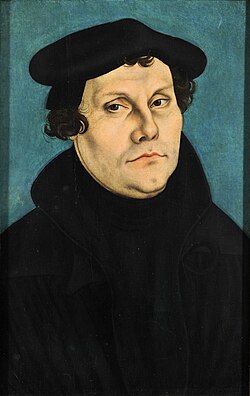
Martin Luther is known worldwide as one of the Fathers of the Protestant Movement. His life story is taught in school textbooks and he has been branded a rebel, a hater of Catholicism and a great voice of change. But, Luther was simply a man who stoically stood for the Truth with only the Word of God to back him up. He was a quiet voice calling for a return to doctrinal principles trying to draw people's attention back to a compassionate God during a time when the papacy and nobility had turned Christianity into a money-minting machine. This is his story.
Baby Steps
On November 11, 1483, Hans and Margaret Luther welcomed their first-born son Martin into the world. Through the winter months of 1483 – 84, their little family resided in the town of Eisleben. Hans worked in the mines and Margaret kept the house, but they then moved to Mansfield. He was taught to memorize the Ten Commandments, the Lord's Prayer and the Apostle's Creed. In the manner of most children, he learnt the words but didn't truly understand their meaning. When his parents took him to church every week, he looked upon the swordholding face of Jesus Christ he knew as an all-powerful Judge. As he grew, these firm teachings became fixed in his mind.Martin's school days were filled with the learning of Latin, a language taught by brutal methods that created a thorough dislike of it in every child's mind.
In the year 1497, Martin was sent to the cathedral school of Magdeburg where the gentle Brethren of the Common Life taught him.
This quiet goodness and firm peace sank into Luther's nature. And this time when he returned home, his mother suggested that he go back to her own home in Eisenach and spend a year studying there.
John Braun, vicar of St. Mary's Church in Eisenach is especially notable for bringing into Martin's mind a desire for the religious calling. Then at the age of eighteen, Martin was sent to the greatest of medieval German universities, Erfurt.
Hans wanted his son to be a lawyer and Martin although not completely willing, excelled in his studies. On one trip home, he was thrown from his horse when lightning suddenly struck, and he prayed that he would devote his life to becoming a monk if he was saved from the ordeal. He was, and so he left his career in law behind to become a friar. His father was displeased and the tension between father and son fraught their relationship for several years.
During his years with the Augustinian order, under the strict patronage of the vicar general of the Saxon province, John Von Staupitz, Luther studied theology. By September 1506, he was ready for his final vows. He was tonsured and the long, flowing black robe was put on him.
Unworthiness
The whole problem of his life, since he first felt the call of religion in boyhood was the problem of sin and the acceptance of his life in the sight of God. He felt so thoroughly his own sinfulness that he could not understand how anyone could be justified in the sight of God. And so, day after day, He plunged into prayer, fasting, and ascetic practices—going without sleep, enduring bonechilling cold without a blanket, and flagellating himself. But Luther was not being abused by the order, he was seeking to know that he was worthy and well-accepted in the sight of the God he served.Due to Martin's excellent record at university and in the monastery, his superiors treated him with kindness and encouraged his theological studies. His inner strife and feeling of unworthiness constantly terrified him as he went on, at the age of twenty-three, to be ordained as a priest of the Western Catholic Church in April 1507.
Luther's personal religious development paralleled his theological and biblical study in the Erfurt monastery. On one hand, there were professors who taught that man could attain righteousness by his own action and on the other hand, were the Scriptures which stated the immovable righteousness of God which was given freely to humans. He studied the red-bound Bible given to Martin by the Augustinian order so often that he could quote whole passages by heart.
The medieval church had ample cause of beware of the independent study of Literature, as History bears witness to the exceptional strength of Scripture to make me think and act along independent lines.
As Luther thrived at Erfurt and the man most influential in his development, John von Staupitz moved Luther from Erfurt to the University of Wittenberg.
At Wittenberg, he studied the Bible with an emphasis on philosophy which he did not much like. But earning his doctorate was necessary if he wanted to teach the Bible. In the fall of 1509, he earned his first degree from Wittenberg.
The Fall Of Rome
Then in October 1510, Luther had the opportunity to visit Rome, as a representative for an administrative difficulty. As he travelled through Northern Italy and came to Florence, he heard with amazement stories of the papal court at Rome and saw the debaucheries of the churchmen.As they completed their responsibilities, Luther had a chance to walk through the Great Sacred Stairs (believed to be the steps Jesus walked on when He met Pilate). Pope Leo IV had granted an indulgence (forgiveness of sin gained through an action or money) of nine years for each of the 28 steps. And so devout Catholics made this journey as a penance for sins. The story goes that as Luther walked halfway up these stairs, he remembered the verse “the just shall live by faith” and walked back down.
Luther was not putting on a show on rebellion through this, but the Holy Rome of his dreams was no longer a reality. Due to the secular Renaissance papacy, the moral life of Rome had degenerated rapidly. Pope Innocent VIII had attended his own daughter's wedding in the company of his mistress. The whole family of the Borgias had marked Rome with many scandals and immoderate living.
Luther did nothing to rebel against Rome in the few weeks that he stayed there but the seeds had been sown.
The Wittenberg Theses
On October 18, 1512, he received his Doctor of Theology degree and the University of Wittenberg admitted Luther to its staff of professors. In the tower of the Black Cloister, he kept his attention to the text in Romans 1:17: “The just shall live by faith”. His university lectures on the Psalms were usually in a combination of the local language and Latin, in a manner that made it very relatable to his students. As Luther's sermons developed a distinct quality and he published his first book A German Theology, he was made the district vicar of the monasteries at Thuringe and Meisen. He found all hours of his day filled with important responsibilities, but humility, gentleness and deep piety remained the root characteristics of his life. Even when the plague ravaged his town, he remained at his station.But absurdities like the selling of relics (objects that claimed to have spiritual power) disturbed him greatly. Things had reached such a situation that Luther's own parishioners were being led astray. As per the orders of Archbishop Albert and the Pope Leo X, the prior of the nearby convent at Leipzig, John Tetzel urged these poor peasants to buy these indulgences claiming that they could ensure that their dead relatives and they themselves would go to heaven.
Several leaders around the world were calling for a cleaner, higher administration and a thorough reformation, but Luther in his corner of Wittenberg knew nothing of this oncoming tide.
But he was an eloquent spokesman and through his sermons, he championed the peasant and challenged the nobility for their oppression and proclaimed that the rulers must answer to the Scripture for their unchristian exploitation.
At noon on All Saints Day, a single sheet of paper was nailed to the door of the Wittenberg Cathedral Church.
This document containing 95 propositions regarding the truth of the Scripture, and the wrongness of acts like indulgences cut straight through the despicable acts of the papacy. Printers rapidly made both Greek and German copies of the 95 Theses and that reached far and wide.
The Rebuttal
Luther wrote to Leo X in May 1518. The secular-minded pope did not know what to think of such religious fervour and immediately tried to put an end to Luther's words haphazardly. This move did not work, and the situation worsened as the peasants began gaining strength and revolting against the nobles.Leo X believing that this was simply the work of a drunken monk ordered the general of the Augustinian order to deal with the matter. At the meeting, Luther defended his theses and resigned as the district vicar.
The first of many times when Luther would have to defend his action happened in 1518, before the Cardinal Cajetan who refused to even let Luther talk and threw abuse until Luther himself shouted. The second and third meetings were the same story: a call for recantation and a refusal.
Luther's next major debate was with Eck, a bull-like Dominican monk and professor. The situation had grown so bad that Luther had to travel with a 200-strong procession. The debate ended with Eck branding him a heretic and getting the Pope to sign the decree 'Exurge Domine'. It called upon Luther to recant within 60 days or be excommunicated. Luther responded by burning the decree with several other papal decrees.
On January 25, 1521, Luther was invited to the town of Worms, a German town on the Rhine.
This meeting was to be in the presence of Emperor Charles V to determine whether Luther's writing was heretical enough to excommunicate him. Over the course of several furious debates, Luther stated why his words only defended the truth of the scripture in both Latin and German against Eck, who continually vehemently demanded his recantation.
He replied, "Unless I can be instructed and convinced with evidence from the Holy Scriptures or with open, clear, and distinct grounds of reasoning...then I cannot and will not recant" Then he added, "Here I stand. I can do no other. God help me! Amen."
The Emperor presented the final draft of the Edict of Worms on 25 May 1521, declaring Luther an outlaw, banning his literature, and requiring his arrest: made it a crime for anyone in Germany to give Luther food or shelter.
Family And Work
Luther then went underground as a knight named St George and stayed at the castle of Wartburg under the protection of Prince Frederick III, Elector of Saxony. During his time there, he prolifically wrote and penned down a German translation of the New Testament, several sermons, hymns and tracts. One of his earliest writings, The Small Catechism has earned a reputation as a model of clear religious teaching and still remains in use today.But as Luther stepped away from leadership, far more vehement colleagues like Bodenstein began taking over the revolution and moving it in a violent direction. While Luther agreed with the need for a peasant revolt, he didn't support the violence they promoted. He mocked fellow reformers, especially Swiss reformer Ulrich Zwingli, who supported this.
A constant source of joy in his life was his marriage to Catharine Bora, a runaway nun. Their home was one filled with a lot of happiness with six children.
As the constant pressure of public life began breaking him, he grew touchy and sensitive.
Towards the end of his life, he could feel his day approaching and was eager to meet His Lord and Maker. He continued his responsibilities and after solving a dispute at Eisleben, he felt feverish and sick. Finally, with the words “Who hath my word shall not see death" on his lips, Martin Luther left the world.
The world, however, did not let Luther rest. Every Protestant Reformer—like Calvin, Zwingli, Knox, and Cranmer—and every Protestant stream—Lutheran, Reformed, Anglican, and Anabaptist—were inspired by him in one way or another. On a larger canvas, his reform unleashed forces that ended the Middle Ages and ushered in the modern era.
Luther's firm stance about the scriptures is one that all of us today have a lot thank for and one that we should emulate in this swiftly changing world.
This article originally appeared in the Harvest Times magazine's Novemeber 2017 issue.